


Priority conservation areas and global population estimate for the Philippine eagle
Updated: Feb 28, 2023
The Philippine Eagle Foundation announces its latest scientific paper published online in the prestigious journal Animal Conservation .
Latest scientific information on the mighty Philippine eagle will help save this
“Critically Endangered” national symbol

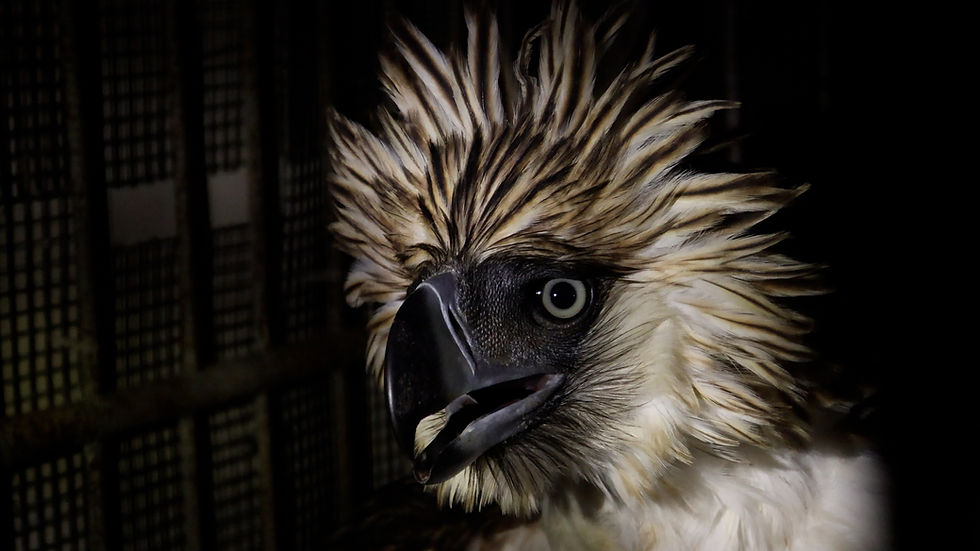
The top carnivore of the Philippines is a Bird of Prey called the Philippine Eagle.
Davao City, Philippines. The Philippine archipelago is one of the most biologically diverse places on the planet. Molded by millions of years of evolution, the ancient forests of its tropical islands are home to a multitude of plants and animals found nowhere else on Earth.
Performing a very important ecological role at the top of the country’s exceptional ecological pyramid is an equally unique apex predator. But while most of the world’s top carnivores are mammals – like the iconic African Lions and Sumatran Tigers – the Philippine’s top carnivore is a forest eagle. This “Bird-of-Prey” is the great and mighty Philippine Eagle Pithecophaga jefferyi.
Found only on the four big islands of the country (Luzon, Leyte, Samar and Mindanao), territorial pairs of Philippine Eagles have played an important role in the Philippine Forest ecosystem as “ecological keystones” for eons.
But mighty as it is, the existence of the Philippine’s national symbol is imperiled. Declared by the International Union for Conservation of Nature (IUCN) as “Critically Endangered” since 1996, deforestation of its precious habitat and human persecution through shooting and trapping still threaten its existence. The serious lack of scientific information required for decision-making also limits the effectiveness of conservation actions.
“Despite being one of the most endangered forest eagles in the world, we still lack fundamental information regarding Philippine Eagle distribution and population size” says Dennis Salvador, Executive Director of the Philippine Eagle Foundation and co-author of the paper “Priority conservation areas and a global population estimate for the critically endangered Philippine Eagle” published in the journal “Animal Conservation”. “This is very upsetting considering that the world might lose this majestic eagle within this lifetime if we don’t act fast to save it” says Director Salvador.
“Understanding how species are distributed and a reliable estimate of population size are key biological parameters for any threatened species” says Luke Sutton, Post-Doctoral Research Fellow at The Peregrine Fund in Boise, Idaho, USA and lead author of the paper. “Establishing baseline estimates for both of these parameters is critical for directing conservation planning for at-risk endemic species like the Philippine Eagle” Dr Sutton added.
The paper had two major parts. The first part presented two key components: (i) an updated approach to estimating IUCN range metrics, and (ii) population size estimation based on modelling highly suitable eagle habitat and the latest average area requirement of one territorial eagle pair measured using “state-of-the-art” satellite telemetry techniques.
Because not all types of forests are used by the eagles, it is very important to know which ones are suitable in order to adequately protect its resident eagles. Using a “Species Distribution Model”, or SDM approach, a total of 2,862,400 hectares of forest were predicted to be suitable for the eagles. This “Area of Habitat”, or AOH, is equivalent to a little over twice the total land area of Samar Island. It also covers only 10 % of the total land area of the Philippine archipelago.

Philippine Eagle being monitored in Mt Apo with its solar powered GPS tracker on its back, which is attached using a harness.
Using the latest telemetry data on the average home range size requirement of an eagle pair, we now know that this amount of suitable habitat could support an average of 392 Philippine Eagle pairs or a range between 318-447 pairs. Since 2008, the Philippine Eagle Foundation has installed miniature GPS trackers on nesting eagles using backpack harnesses. Through these satellite telemetry techniques, we know and understand better eagle movement patterns and how they use the forests in the wild.
By using the latest satellite images of forest vegetation and human landscapes, the SDM approach also predicted which land cover types are favored and avoided by eagles. For example, eagles appear to hunt and nest in forests that have dense, healthy green plant biomass, old-growth (very large) trees and multi-layered canopy cover.

A reclassified binary model of suitable eagle habitats measured a total of as 2,862,400 hectares as shown in light green while yellow polygons are non suitable habitats.
The eagles also seem to avoid parts of the forests that have thick or closed canopies (leaf and canopy biomass). They generally prefer areas with 70-80 % forest cover as habitat. Interestingly, the paper also predicted that Philippine Eagles tolerate areas of low human impact (scattered small villages in between forests) but avoid areas of high impact human infrastructure.
On the other hand, the second part of the paper demonstrated how our methodology can improve species conservation planning by mapping out using Geographic Information System (GIS) which priority eagle conservation areas were missed by the current protected area coverage. The current Philippine protected area network covered only 32% of the total suitable eagle habitats. This is 13% less than the minimum standard target of 45 % coverage based on our estimation of Philippine Eagle range size.
On Mindanao, priority eagle habitats that need immediate protection are: (i) Mt Hilong-hilong, (ii) Mt Kampalili-Puting Bato, (iii) Mt Latian complex, and (iv) Mt Busa-Kiamba. Protected areas could also be extended in the Mt Piagayungan and Butig Mountains and Munai/Tambo Key Biodiversity Areas in east-central Mindanao. In northern-central Mindanao, priority for protection include the Mts Kaluayan – Kinabalian Complex (or the Pantaron Ranges) along with the adjacent Mt Balatukan, and the Mt Tago Range.
The priority eagle habitat on Leyte Island is the Anonang-Lobi Range in Leyte Province, and Mt Nacolod in Southern Leyte. Both are highly suitable eagle habitats, but the latest expeditions indicate that eagles might have been lost already at these places. These habitats can be future sites for eagle reintroductions.
For Northern Luzon, priority for proposed new protected areas include the (i) Apayao Lowland Forest and the (ii) Balbalasang-Balbalan moutains to cover further high suitability habitat. Lastly, the Zambales Mountains could also be upgraded for protection if surveys identify a population here. Otherwise, the mountain should be prioritized for potential reintroductions.
“The information and insights contained in the paper have substantially improved our knowledge and understanding of the status and conservation needs of the Philippine Eagle in the wild” says Jayson Ibanez, Director of Research and Conservation at the Philippine Eagle Foundation and also a co-author of the new publication.
“With the accurate population baselines that we now have, and the fact that the species remains heavily persecuted in the wild, we can re-program and prioritize our actions, by (i) finding as many of these 392 territorial nesting pairs across the country as possible through systematic nest surveys, (ii) protect as many of the threatened eagle nest sites through improved education outreach, wildlife law enforcement and community-based conservation, and (iii) ensure the reproductive success and survival of each adult pair and each of the young they hatch through telemetry and field monitoring” says Dr Ibanez.
“We are thrilled to analyze decades worth of the hard-earned field data collected by our colleagues at the Philippine Eagle Foundation” says Chris McClure, Executive Vice President of Science and Conservation at The Peregrine Fund and co-author of the paper. The Philippine Eagle Foundation is an active member of the Global Raptor Impact Network - a network and database for studying and conserving the world’s raptors that is convened by The Peregrine Fund. “The scientific and grassroots approach of the Philippine Eagle Foundation and its network of government, private sector and community collaborators is an ideal model for national raptor conservation.” Dr McClure added.
In addition to the people quoted above, this study was contributed to by Biologist Rowell Taraya and Tristan Senarillos, and GIS Specialist Guiller Opiso of the Philippine Eagle Foundation.
About the Philippine Eagle Foundation (https://www.philippineeaglefoundation.org/): Founded in 1987, The Philippine Eagle Foundation is non-governmental organization based in Davao City, Philippines. It is the only conservation organization in the world whose sole purpose is to conserve the Philippine Eagle and its rainforest habitat through a holistic approach that includes (i) field research, (ii) forest protection and restoration, (iii) culture-based conservation with Indigenous peoples and upland communities, (iv) education and public awareness and (ii) eagle rehabilitation, conservation breeding and releases.


trang chủ fly88 khiến mình muốn quan sát kỹ hơn cách những nội dung cụ thể được đặt trong từng khu khi nhu cầu thay đổi. Thể thao là hướng mình từng dành thời gian, trong đó bóng đá thường giúp mình tập trung vào một nội dung rõ ràng hơn. Mình sử dụng trên điện thoại ở một số lần nên cũng dần quen với cách thao tác khi tìm phần muốn theo dõi. Khi quay lại sau đó, những bước đã quen giúp mình xác định hướng khá nhanh. Qua thời gian, việc tìm đúng khu trở nên tự nhiên hơn và mình có thể tập trung trực tiếp vào nhu cầu hiện tại.
ae8888 giúp tôi chú ý đến cách giao diện duy trì trạng thái quen thuộc khi người dùng di chuyển giữa các trang. Tôi thử mở nhiều khu vực rồi quay lại trang trước để kiểm tra khả năng định hướng. Tiêu đề và vị trí điều hướng là hai phần tôi quan sát nhiều nhất vì chúng giúp xác định nhanh vị trí hiện tại. Sau khi đã kiểm tra tổng thể, tôi quan sát Casino, thể thao, bắn cá và nổ hũ ở giữa để xem các nhóm được tổ chức ra sao. Khi bố cục không thay đổi quá đột ngột, tôi dễ duy trì mạch thao tác và ít bị gián đoạn. Đây là điểm phù hợp…
ae888 com giúp tôi đánh giá cách trình bày các chức năng hỗ trợ người dùng. Tôi thường tìm khu vực liên hệ trước rồi mới chuyển sang những nội dung giải trí để xem khả năng quay lại có thuận tiện không. Khi kiểm tra Thể thao, Casino, Bắn cá và Nổ hũ, tôi chú ý đến vị trí các nút hỗ trợ và cách chúng được hiển thị trong từng trang. Điều tôi quan tâm là khi cần tìm hướng dẫn, người dùng có thể xác định đúng khu vực mà không phải mở quá nhiều mục. Tôi cũng thử quay về trang chủ sau mỗi lần chuyển sảnh để kiểm tra tính nhất quán. Từ trải nghiệm này,…
At https://casino-mit-cashlib.de, I'm used to weighing odds before committing, so reading about the Philippine eagle's updated population estimate and the modelling of suitable habitat felt like a similar kind of risk assessment—only the stakes are extinction. The fact that they're using range metrics to pinpoint priority areas is exactly the kind of concrete data conservation decisions need. It makes you wonder how many other critically endangered species are still flying blind.
trang chủ xx88 khiến mình quan tâm đến cách các thành phần trên màn hình phản hồi khi mình thay đổi thứ tự khám phá. Mình thường nhìn vào tiêu đề và vùng nội dung sau mỗi lần chuyển để nhận biết phần nào vừa được mở. Có lúc mình đi từ Đá gà sang Xổ số rồi Bắn cá, lần khác lại đổi thứ tự để quan sát cách giao diện thể hiện từng trạng thái. Menu vẫn nằm trong cấu trúc quen nên mình có một điểm tham chiếu chung dù hướng sử dụng thay đổi. Khi muốn tìm lại khu đã xem trước đó, mình chủ yếu dựa vào những dấu hiệu trực quan này. Với mình, cách…