


Another Eagle, Another Shooting: A Warning from the Forests of Magpet
Updated: 1 day ago
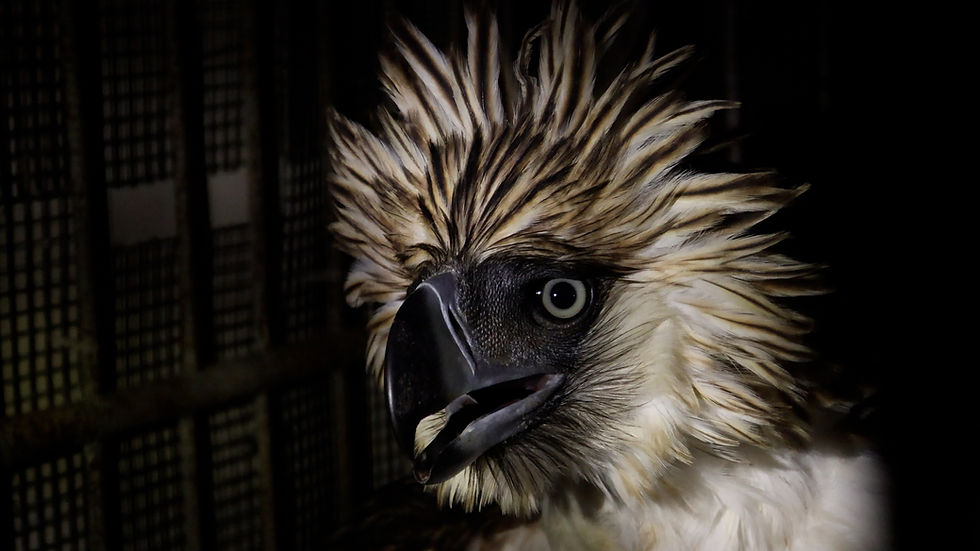
MAGPET, COTABATO — Another Philippine Eagle has survived a shooting.
A young eagle rescued in Barangay Manobo, Magpet was found carrying three airgun pellets inside its body—a painful reminder that one of the world’s rarest eagles is still being harmed by people.

The eagle was found weak on the evening of September 27, 2026. It was turned over to the Department of Environment and Natural Resources–Community Environment and Natural Resources Office and later endorsed to the Philippine Eagle Foundation for examination and care.

Initial examination identified the bird as an approximately five-year-old, presumed female Philippine Eagle weighing 5.15 kilograms. Despite what it had gone through, the bird was still bright, alert, and responsive.
Three airgun pellets in one eagle
The X-ray revealed something painful to see.
Three airgun pellets were lodged inside the eagle’s body—one near the right wing, one near the right leg, and another near the base of the tail.

Two of the pellets were close enough to the surface to be removed by the veterinarian under local anesthesia.
No fresh entry wound was seen during the initial examination, which means the eagle may have been carrying these pellets for some time.
The eagle cannot tell us who shot her, when it happened, or why.
What we know is that she survived.
For a Philippine Eagle, even one shot can mean broken bones, infection, loss of flight, or death.
This eagle was carrying three pellets.
And this is not the first time an eagle from Magpet has suffered from gunfire.

A warning we have seen before
In 2013, a juvenile Philippine Eagle was also rescued in nearby Barangay Amabel, Magpet.
That bird did not survive. It later died from a .22-caliber gunshot wound.
More than a decade later, another young eagle from the same wider landscape has been found with projectiles inside its body.
The cases are separated by years, but they carry the same warning: Philippine Eagles are still being shot.
“We have seen this happen too many times. Philippine Eagles continue to be shot with air guns and improvised firearms. Our Population Viability Analysis warns that the population could collapse if these human-caused deaths do not stop. Protecting our national bird requires a whole-of-nation effort—from government, communities, Indigenous Peoples, law enforcement, the private sector, and every Filipino.” — Dennis I. Salvador, Executive Director, Philippine Eagle Foundation
These birds do not understand property lines. They move across forests, farms, communities, and open areas in search of food, mates, and safe places to live.
Sometimes, they may prey on domestic animals such as pigs. But these encounters should never end with a gunshot.
One pull of a trigger can kill a bird that took years to grow and survive in the wild.
An ancient eagle territory
The place where the eagle was rescued is also important for another reason.
It is part of an old Philippine Eagle nesting territory, with nesting records going back as early as 1983.
The last confirmed nesting record in the area was in 1990, when an eaglet was verified at the nest.
After that, there were no more confirmed nesting records for many years.
What remained were stories from local people—occasional sightings of a lone eagle flying over the area and reports of eagles taking domestic pigs.
The recent rescue now confirms that Philippine Eagles are still using this landscape.
That matters because this is not just any forest.
The rescue area lies within the greater Mt. Apo Key Biodiversity Area, which covers around 100,000 hectares of forest.
Within this larger landscape are 10 ancient Philippine Eagle nest sites, including the old nesting area near the rescue site.
These places hold a long history of Philippine Eagles.
Even when an old nest is no longer active, the surrounding forest can remain important for hunting, movement, and future breeding.
Protecting forests is not enough
The Magpet rescue gives us two stories at the same time.
The first is hopeful: Philippine Eagles are still present in a landscape where they have lived for generations.
The second is harder to accept: they are still being shot.
Saving the Philippine Eagle therefore means more than protecting trees.
A large forest can remain standing, but an eagle can still be lost in seconds if someone decides to shoot.

This is why communities living near eagle territories are so important to conservation.
If an eagle is seen near farms, livestock, or homes, the answer should be to report it to local authorities, DENR, or the Philippine Eagle Foundation.
The answer should never be a gun.
A chance to recover—and a story to follow
The rescued eagle, now called “Magpet,” remains under close veterinary care. The areas where the pellets were removed are being monitored for swelling, infection, and other complications.
Her rescue is only the beginning.
PEF will continue to share updates on Magpet’s care, recovery, and rehabilitation as veterinarians and keepers work to help her regain strength.
We invite the public to follow the Philippine Eagle Foundation’s official channels for updates on Magpet’s condition and rehabilitation journey.
Every update will be a reminder of what it takes to save one Philippine Eagle—and why preventing the next shooting matters even more.
After more than four decades of records from this landscape, the forests of Magpet are telling us something important.
The eagles are still here.
But so is the danger.
Three airgun pellets inside one young Philippine Eagle should concern all of us.
Because every eagle that survives a shooting is also a warning that the next one may not.


A moving and important conservation article. It is heartbreaking to learn Magpet survived multiple air‑gun injuries, yet so inspiring to witness the coordinated multi‑party rescue effort. This story delivers such a critical reminder: protecting the Philippine Eagle means engaging local communities alongside forest conservation work. All respect for every member of your team caring for this brave eagle. Hoping for steady progress in Magpet’s recovery! --RNGdle