


One Dead Eagle, Two Actions We Cannot Ignore

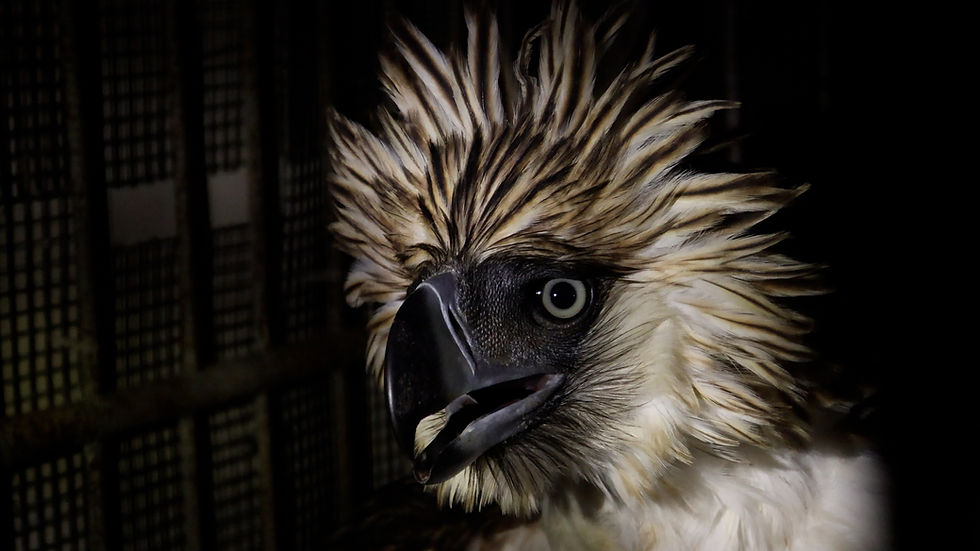
Philippine Eagle found in Salay, Misamis Oriental. The young female Philippine Eagle recovered in Barangay Guinalaban, Salay, Misamis Oriental. Her death adds another important record of Philippine Eagle presence in this part of the province and raises questions about the threats eagles may encounter in the area.
SALAY, MISAMIS ORIENTAL - On October 1, 2026, a young female Philippine Eagle was found dead near an electrical post in Barangay Guinalaban, Salay, Misamis Oriental. People had reportedly seen the eagle flying in the area the day before.
She was estimated to be less than five years old and weighed 5.25 kilograms. On October 2, the Philippine Eagle Foundation’s Resident Veterinarian, Dr. Danielle Kirsten D. Pasion, conducted the post-mortem examination.
Burn marks were found on the eagle’s foot pads, with no other obvious external injuries. Because the carcass was already decomposed, some findings were difficult to interpret. Still, the burn marks and gross internal findings were consistent with suspected electrocution.

Evidence of suspected electrocution. A closer view of the eagle’s foot pads during examination. The visible burn marks became an important physical finding in determining what may have happened to the bird.
For a species as rare as the Philippine Eagle, one dead bird is not simply one dead bird. It can be a warning about a place, a threat, or a population that we have not yet fully understood.
A landscape with a long memory
The death in Salay becomes more important when we look at the history of Philippine Eagles in this part of Misamis Oriental.
In 1984, an adult male Philippine Eagle was rescued in Lagonglong. The eagle, originally named Jag and now known as Dagitab, was kept for conservation breeding and went on to sire six young eagles for the Philippine Eagle Foundation’s conservation breeding program.

Philippine Eagle “Dagitab,” one of the eagles historically associated with the Lagonglong area. Records of individual eagles like Dagitab help conservationists piece together how Philippine Eagles have used this landscape across generations.
A year later, in 1985, a young Philippine Eagle was rescued after it crashed into the sea off Barangay Dampil, also in Lagonglong. This eagle was released back to Lagonlong forest after rehabilitation.
Now, more than 40 years later, another Philippine Eagle has died in nearby Salay. The Guinalaban site and Dampil are only several kilometers apart.
These three records do not prove that the eagles belonged to the same territory, family, or lineage. But together, they raise an important question: has this part of Misamis Oriental been Philippine Eagle landscape for much longer than we realized?
The answer matters. If Philippine Eagles are still using the forests around Lagonglong and Salay, then these forests may deserve much more attention than they have received.
When the powerline becomes a trap
Electrocution is not a problem unique to the Philippines. Around the world, powerlines can become deadly traps for large birds that perch, land, or fly close to electrical structures.
In Mongolia, researchers documented 22 Golden Eagles killed along a single 98-kilometer powerline. Another study recorded 76 electrocuted birds along 133 kilometers of powerlines, including Endangered Saker Falcons.
These numbers show how a single stretch of infrastructure can become a repeated source of wildlife mortality. They also show why finding one dead bird should lead to a closer look at the electrical system around it.
For Philippine Eagles, the risk is especially serious. Every individual matters, and accidental deaths can undermine years of conservation work.
We have already seen this before
The Salay case is also not the first documented accidental electrocution of a Philippine Eagle in the Philippine Eagle Foundation’s records.
The first involved Kabayan, a captive-bred Philippine Eagle that had been released into the wild and later died after coming into contact with electrical infrastructure.

A dangerous perch. This power pole in Barangay Tumanding, Arakan, North Cotabato, was linked to the accidental electrocution of a young male Philippine Eagle from Mt. Sinaka in December 2018. The tragedy helped spur a partnership to retrofit and insulate powerlines around the eagle habitat—turning a wildlife loss into action toward safer infrastructure for Philippine Eagles.
The second documented case occurred in 2018, when a two-year-old free-living Philippine Eagle from Arakan, North Cotabato, was found dead near a powerline. An electrical inspection found an exposed secondary line carrying 220 volts. The eagle apparently contacted two energized wires at the same time, allowing the voltage to pass through its body.
That death led to action at Mt. Sinaka in Arakan, where the Philippine Eagle Foundation had validated a Philippine Eagle nesting site in 1995. At least 11 young eagles have successfully hatched there through years of conservation work.
The Philippine Eagle Foundation, COTELCO, and partners began work to make the powerline safer around the eagle nesting area. Funding for the Mt. Sinaka powerline retrofitting was provided by Suntory Japan through the Asian Raptor Research and Conservation Network (ARRCN). COTELCO contributed manpower, transport, installation, and maintenance support.
In 2023 and 2025, a total of 3 kilometers of the planned 4.5-kilometer powerline retrofit was completed at Mt. Sinaka.
Mt. Sinaka shows that accidental electrocution does not have to remain an unavoidable cost of development. Conservation groups, communities, electric utilities, and international supporters can work together to reduce the risk.
Two actions we cannot ignore
The Salay eagle should therefore lead us to two specific actions in Misamis Oriental.
1. Look for the eagles.
The provincial government of Misamis Oriental, the municipalities of Salay and Lagonglong, DENR, local government units, and conservation organizations should work together to assess the forests around Guinalaban in Salay and Dampil and other suitable areas in Lagonglong for Philippine Eagle presence.
The first step should be targeted field surveys: look for eagle sightings, prey, nesting trees, possible territories, and other signs that could confirm whether Philippine Eagles are still using these forests.
If eagles are found, these locations should be considered for long-term monitoring and protection, rather than treated as one-time sightings.
Local communities should also be encouraged to report eagle sightings, nests, injured birds, and dead birds to the appropriate authorities and to the Philippine Eagle Foundation.
The three historical records may be isolated incidents.
Or they may be pieces of a much bigger story.
We need to find out.
2. Make the powerlines safer.
The electric utility serving the Salay–Lagonglong area, together with DENR, the concerned LGUs, and the Philippine Eagle Foundation, should assess electrical poles and lines located near known or potential Philippine Eagle habitat.
The recently identified powerline near Barangay Guinalaban should be among the sites assessed for potential electrocution risk.
Where dangerous configurations are identified, the utility should develop a schedule for bird-safe retrofitting, prioritizing lines that pass through or close to important eagle habitat.
The Mt. Sinaka experience shows that this is possible.
COTELCO’s partnership with the Philippine Eagle Foundation and other organizations provides a model that can be adapted in Misamis Oriental and by other electric cooperatives across the country.
The goal should not be to wait for another eagle to die before making the next powerline safer.
Bird-safe powerline design should become part of long-term infrastructure planning wherever electrical systems overlap with Philippine Eagle habitat.
A question we should not ignore:
The young eagle found in Guinalaban may have died from one dangerous electrical contact. But her death has opened a much larger conservation question.
How many Philippine Eagles are still using this landscape?
Are there nesting pairs in the forests of Salay and Lagonglong?
And if they are there, what are we willing to do to make sure they survive?
Find the eagles that are still out there. Protect the forests where they live. Protect the eagles from shooting, trapping and hunting. And make the powerlines around them safer.
References and Further Reading
1. Purevdorj, A., et al. (2025). “Electrocution of Steppe Eagles and Golden Eagles in Mongolia.” Journal of Raptor Research, 59(2). DOI: 10.3356/jrr2476. https://meridian.allenpress.com/rapt/article/59/2/1/506609/Electrocution-of-Steppe-Eagles-and-Golden-Eagles
2. Dixon, A., Rahman, M. L., Galtbalt, B., Gungaa, A., Sugarsaikhan, B., & Batbayar, N. (2017). “Avian electrocution rates associated with density of active small mammal holes and power-pole mitigation: Implications for the conservation of Threatened raptors in Mongolia.” Journal for Nature Conservation, 36:14–19. DOI: 10.1016/j.jnc.2017.01.001. https://www.sciencedirect.com/science/article/abs/pii/S1617138117300055
3. Orihuela-Torres, A., et al. (2021). “Avian-power line interactions in the Gobi Desert of Mongolia: are mitigation actions effective?” Avian Research, 12:41. DOI: 10.1186/s40657-021-00277-2. https://link.springer.com/article/10.1186/s40657-021-00277-2
4. Philippine Eagle Foundation (2023). “The country's first-ever Powerline Insulation Project will protect a Philippine eagle family.” https://www.philippineeaglefoundation.org/post/the-country-s-first-powerline-insulation-project-will-protect-a-philippine-eagle-family
5. Philippine Eagle Foundation (2023). “Protecting the Philippine eagles and wildlife of Arakan from accidental electrocution.” https://www.philippineeaglefoundation.org/post/protecting-the-philippine-eagles-and-wildlife-of-arakan-from-accidental-electrocution
6. MindaNews (2023). “Philippine eagles get protection from high voltage bare wires.” https://mindanews.com/top-stories/2023/04/philippine-eagles-get-protection-from-high-voltage-bare-wires/
7. BusinessMirror (2023). “PEF installs retrofitted powerline system to protect eagle family in North Cotabato.” https://businessmirror.com.ph/2023/04/05/pef-installs-retrofitted-powerline-system-to-protect-eagle-family-in-north-cotabato/
8. Philippine Eagle Foundation (2023). “Pag-asa Newsletter, January–March 2023.” https://www.philippineeaglefoundation.org/pag-asa-newsletter-jan-mar-2023 Philippine Eagle Foundation – Feature Draft | October 2026


Comments