


Tuglivon Is Still Flying
Updated: May 14
A young Philippine Eagle carries an old Obu Manuvu story of renewal
By Ron Taraya | Senior Biologist, Philippine Eagle Foundation

The call was thin but strong. It carried across ridges, trees, and patches of farmland where the forest still holds on. I knew that voice. It belonged to Tuglivon, the eaglet we had watched since he was a chick, the young eagle we had trapped, checked, tagged, released, and followed through one of the most dangerous stages of his life.
He was still there. He was alive. He was learning.
His name comes from an old Obu Manuvu story. In that story, Tuglivon was a bird that helped save the land after a great flood. The floodwaters could not drain because pieces of wood had blocked the holes of the earth. Tuglivon found the debris and removed it. When the blockage was cleared, the water finally flowed away. The land breathed again, and life returned.
That story made the name powerful. The Obu Manuvu community of Tambobong gave the eaglet the name Tuglivon through a naming ritual. It was not only a name. It was also a thanksgiving gesture. For the community, a new Philippine Eagle chick means the forest is still healthy. If a forest can still feed two adult eagles and raise a chick, then it can also support the people who belong to it. It can meet their material needs, like food, water, and shelter. It can also meet their spiritual needs, giving them identity, memory, and sacred connection to the land.
That is why Tuglivon carries more than a leg band and transmitter. He carries a story, a blessing, and a hope for renewal.
I first knew Tuglivon as a chick in the interior forests of the ancestral domain. We keep the exact nesting area confidential to protect him and his parents. What I can say is that the place is rugged and alive. It is a landscape of ridges, river valleys, forest patches, old trees, farms, trails, and steep slopes. It is not untouched wilderness, but it is still a working forest. It still gives life.
When Tuglivon was young, he depended completely on his parents. Like all Philippine Eagle chicks, he needed a large, safe territory with enough prey and tall trees. His parents had to hunt, return with food, guard the area, and keep him alive through rain, heat, hunger, and danger.

When he fledged, or left the nest tree, we saw the first big step in his life. A young eagle leaving the nest is not just a bird learning to fly. It is a sign that the forest has produced another chance for one of the rarest eagles on Earth.

In July 2025, our team returned to the interior parts of the ancestral domain to monitor and tag him. For days, we watched from careful observation points. We listened for his food-begging calls. We scanned the ridges. We watched the canopy. We waited for the right moment.
He was still young then. He still called to his parents for food. We also saw signs that the adult eagles were still caring for him. These signs mattered. They told us that the eagle family was still together and that the territory was still doing its job.
On July 7, 2025, after days of careful preparation, we safely captured Tuglivon using a bow-net trap. I was there when we handled him, together with Dr. Monica Atienza of UPLB, who led the veterinary examination.

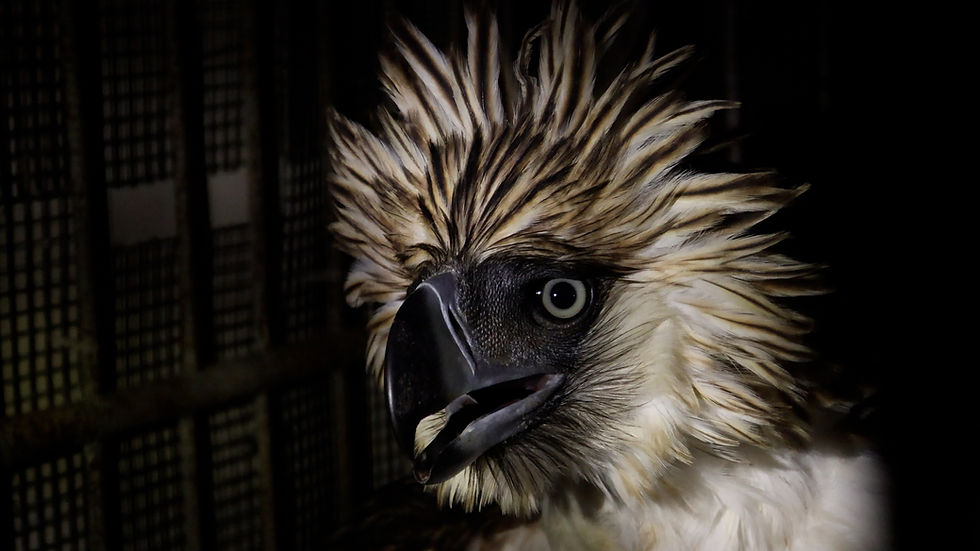
No matter how many times you work with Philippine Eagles, holding one is never ordinary. Even as a juvenile, Tuglivon was powerful. His eyes were alert. His feet and talons reminded us of the hunter he was born to become. But he was also still young, still learning, still standing between childhood and independence.
Dr. Atienza examined him carefully. Tuglivon weighed 3.3 kilograms, a weight consistent with a young male Philippine Eagle. His eyes and ears were clear. His plumage was clean. He had only a few parasites. His tail feathers showed small stress marks, likely from early hunting attempts and flight practice. To me, those marks told a story. He was already beginning the hard work of becoming an eagle.

We fitted him with a GPS-GSM transmitter, a VHF radio transmitter, and a green leg band. These were not just tools. They were lifelines. They allowed us to follow his movements, learn how he used the forest, and check whether he survived after release.

After the health check and tagging, we released him back into the wild.
Watching him return to the forest was a quiet relief. But the real waiting began after that. For a young Philippine Eagle, survival after fledging is never sure. He must learn how to fly well, choose safe perches, avoid danger, respond to other birds, practice hunting, and later leave his parents' territory.
A few days after tagging, we confirmed that Tuglivon was still moving within the ancestral domain. He had survived the capture, handling, tagging, and release. He was still home.
Nearly a year later, in May 2026, local partners told us that Tuglivon had been seen again in the interior parts of Tambobong. I joined the team again with PEF staff, Bantay Bukid, local Indigenous partners, Davao PSSO, City ENRO, CENRO Davao, and Apo Agua.

The reports were true.
Early one morning, we saw a large raptor flying over remnant forest. We confirmed it was Tuglivon. Soon after, he perched on an emergent tree, high enough for us to see him clearly. For several minutes, we documented him and watched him in the morning light.
Seeing him again after many months was deeply meaningful. He was not the same young bird we had tagged in July. He looked stronger. His posture was steadier. His flight was better. His feathers and behavior showed that he was healthy and fit.
Later that morning, we found him again by following his food-begging calls. At nearly one and a half years old, Tuglivon was still calling, perhaps just in case his parents still had food to deliver. But he was also nearing the time when he would have to leave his parents' territory. For now, he was moving, exploring, and learning the wider forest landscape of his natal home, preparing for the difficult life of a Philippine Eagle on his own.
We watched him preen and maintain his feathers. We saw him make short flight transfers. We saw crows mob him, and we watched him move into more hidden forest. These moments may sound small, but they are important. They show how a young eagle learns to react, hide, move, and survive.
Over three straight days, we heard and saw Tuglivon in the forested interiors of the ancestral domain. At one point, he perched on a large dead branch along a ridge. Later, he dropped below the branch and disappeared into the canopy. After a night of heavy rain, when visibility was poor and movement was unsafe, we still saw him again before we left the area.
That is his status now: alive, active, calling, moving, and learning.
Tuglivon is approaching independence. This is one of the most important and dangerous stages in the life of a Philippine Eagle. A chick that survives to fledging has passed one big test. But a fledged young eagle must pass another. He must become a hunter. He must learn safe routes through forests and edges. He must avoid threats. And one day, he must find his own place.
If Tuglivon survives this next stage and eventually leaves the greater Mt. Apo landscape for another isolated mountain range in Mindanao, he will carry more than his own life with him. He will carry his parents' bloodline. He will carry their genes, the living instructions passed from parent to chick. In a species with few remaining breeding pairs, every young eagle that disperses can help renew the population.
If he reaches maturity, claims a territory, and pairs with a monogamous mate, Tuglivon may one day pass his family's genes to a new generation. His flight away from his parents' territory will not only mark his independence. It may also help continue the long cycle of renewal for the Philippine Eagle.
The forest around him is also telling us something. During our short survey, we recorded many birds in the same landscape where Tuglivon is learning to live. We saw hornbills, parrots, forest raptors, montane birds, and other species found only in the Philippines or in Mindanao. In just a few days, we recorded 92 bird species. Many of them were endemic, meaning they live naturally only in this part of the world.

This matters because Tuglivon does not live alone. A Philippine Eagle is a top predator, but it depends on a whole living system below it. It needs prey. Its prey needs trees, fruit, insects, and cover. The trees need soil, water, and people willing to protect them. When an eagle chick grows in a forest, it means many parts of that forest are still working together.
That is exactly what the Obu Manuvu naming ritual reminds us. Tuglivon is not only a conservation success. He is a living sign that the forest still works. A forest that can raise a Philippine Eagle chick is a forest that still has food, water, shelter, and spirit. It can sustain the eagle family in the canopy and the human community below.

This is why protection must continue. Tuglivon needs forest. He needs prey. He needs safe ridges and canopy routes. He needs communities who will continue to watch over the land. He needs Bantay Bukid, Indigenous leaders, local partners, government offices, and conservation workers to keep working together after the field teams leave.
When I think of Tuglivon, I think of the bird in the old Obu Manuvu story.
That first Tuglivon removed the wood that blocked the land and allowed the floodwaters to drain. The young eagle we follow today is not draining a flood. But his survival clears another kind of blockage. It clears doubt. It opens a path for hope.
In the Obu Manuvu ancestral domain of Tambobong, Tuglivon is still flying.
And like the bird whose name he carries, his life tells us that renewal is still possible.


The story of Tuglivon continuing to fly is a meaningful reminder of the importance of conservation work and long term care for threatened wildlife. Following the progress of an individual eagle can make broader conservation efforts easier for readers to understand because it gives the story a personal connection. I appreciate articles that help people become more aware of wildlife protection without losing sight of the individual animals involved. Attention to care and maintenance also https://usvacuums.com/ matters at home, including regular cleaning with suitable products.
Conservation stories become especially meaningful when they focus on individual animals and the broader efforts behind their protection. Learning that Tuglivon is still flying is encouraging because it reflects the dedication of those working to preserve endangered species. The article communicates both hope and responsibility in a balanced way. Supportive expertise matters in many areas, and https://www.floridaprobatelawgroup.com/ similarly emphasizes guidance and dependable service for families dealing with important legal matters.
This was a beautifully told story about Tuglivon and the meaning carried by his name and journey. I especially appreciated how the eagle’s survival is connected with the Obu Manuvu community, the forest, and hopes for renewal. I recently came across https://www.phonydiploma.com/ during a related reading session, and it reminded me how meaningful well-documented stories can be.
If someone forgets their password or cannot access their account, what is the recommended procedure for Amar Club Login? A detailed explanation of the recovery steps would make the process easier for users who experience login difficulties.
Does 69 Game provide any beginner-friendly instructions for understanding its different sections? I’m looking for a basic explanation rather than promotional information, especially about how the interface is organized.