


Two Wounded Eagles, and a Warning Written in Their Genes
A new Philippine Eagle genome study shows why saving the species now means protecting both birds and bloodlines.
Jayson C. Ibanez

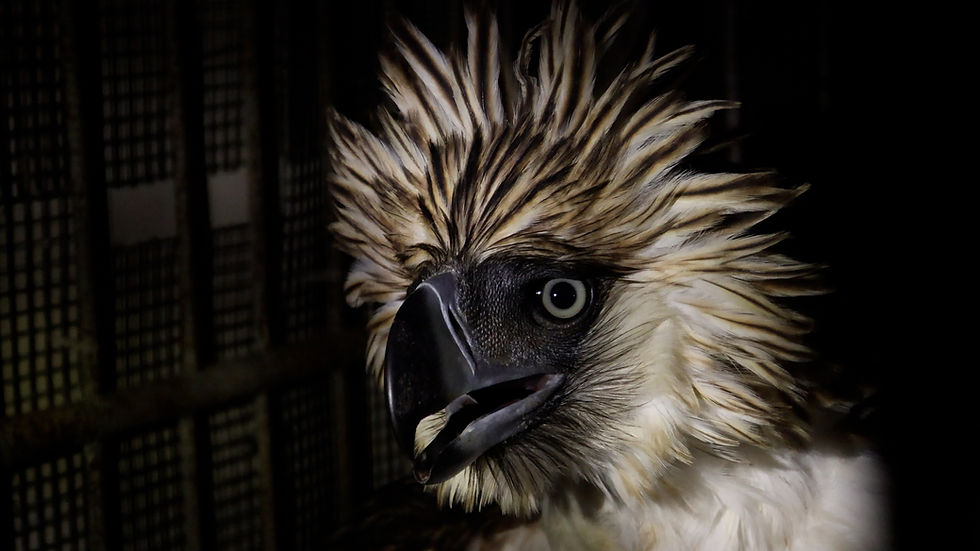
CJ, also known as Lipadas, survived a marble gun. The shot cost him his right eye.
Gavra Maslog survived a trap. But before she was rescued, people had already cut into her body. The tips of her talons were sawn off and ground, reportedly to be fed to fighting cocks in the belief that the eagle’s strength could be passed on to them. Some of her flight and tail feathers were also removed as souvenirs.
These are the wounds people can see: a missing eye, damaged talons, missing feathers, and a life changed by cruelty and superstition.

But a new study shows that Philippine Eagles may also carry another kind of wound—one hidden inside their genes.
A new paper in BMC Genomics by Dhan Mikhail Perdon, Franchesca Pascual, Francis Tablizo, and colleagues studied the genomes of 35 Philippine Eagles under the care of the Philippine Eagle Foundation. The study found that the Philippine Eagle has extremely low genetic diversity—among the lowest measured in raptors. It also found signs of a long population decline, including two old population crashes and an ongoing decline that may have started thousands of years before the modern loss of forests in the Philippines.

For CJ/Lipadas and Gavra Maslog, the finding is especially painful. Among the 35 eagles studied, they had the lowest heterozygosity levels. In simpler words, they carried the lowest measured genetic variety among the sampled eagles.
They were already victims of human harm. The genome study now shows that they also belonged to the most genetically vulnerable end of an already endangered species.
For Dr. Cynthia Palmes Saloma, Dean of the College of Science at the University of the Philippines Diliman, Director of the Philippine Genome Center Program on Biodiversity, Ethnicity and Forensics, and the study’s corresponding author, the study is a reminder that conservation must now look beyond the number of eagles left.
“This study tells us that the Philippine Eagle is not only rare in the wild; it is also genetically fragile. Every eagle we lose may carry genetic variation that the species can no longer easily replace. Genomics gives conservationists a clearer way to protect what remains, guide responsible breeding, and strengthen the long-term survival of our national bird.”
— Dr. Cynthia Palmes Saloma.
The key word in the study is heterozygosity. It sounds technical, but the idea is simple.
Heterozygosity means genetic variety. A population with more genetic variety has more chances to adjust to disease, environmental change, and future breeding problems. Genetic diversity is therefore a species’ survival toolkit. A population with very low genetic variety has fewer options.
Dhan Mikhail Perdon, co-lead author of the paper, current graduate student at NIMBB UP Diliman and Research Associate at the Core Facility of Bioinformatics of the Philippine Genome Center, UP System, explains it this way:
“Heterozygosity is one way of measuring how much genetic variety an animal still carries. In simple terms, it tells us how many biological options a species has left. Higher genetic diversity gives a population more chances to cope with disease, environmental change, and future breeding challenges. When heterozygosity is very low, as we found in the Philippine Eagle, the species has fewer options. It does not mean extinction is certain, but it means every eagle, every bloodline, and every breeding decision matters much more.”- Dhan Mikhail Perdon
The study estimated the average genome-wide heterozygosity of the sampled Philippine Eagles at 0.000309. Some individuals had even lower values, reaching 0.000207. The paper says this is one of the lowest values reported among raptors with available data.
That number matters because the Philippine Eagle is already in trouble. It has a very small wild population. Their forest habitat is broken into smaller pieces. Some eagles are still shot, trapped, or harmed by people. When a species is already rare, low genetic diversity makes recovery harder.
This is the double blow.
An eagle can survive a trap. A wounded eye can be treated. Feathers can grow back. But lost genetic diversity is much harder to replace. Once a bloodline disappears, it may be gone forever.
The study also shows that the Philippine Eagle’s problem did not begin only with recent deforestation. The genome tells a much older story. The species went through major population crashes in the past. More recently, its population appears to have been declining for around 3,000 years. This means today’s threats—forest loss, hunting, trapping, shooting, mining, and human disturbance—are now hitting a species that may have already been weakened over a very long time.
This is where conservation breeding becomes very important.
In the wild, Philippine Eagles breed very slowly. A female usually lays one egg every two years. The pair needs a large forest territory. The young eagle must survive many dangers before it can become a breeder. If forests are far apart, unrelated eagles may not easily find each other.
In captivity, conservationists can help in ways the wild population may no longer be able to do quickly enough.
They can carefully pair eagles from different bloodlines. They can avoid pairing close relatives. They can choose pairings that protect rare genetic lines. With genome data, breeding decisions can become smarter and safer.
Captivity can also increase a female eagle’s breeding potential. In the wild, one egg every two years is equal to about half an egg per year. Under carefully managed captive-breeding conditions, a method called double clutching can allow a female to lay two eggs in one year. That is four times higher. So, it is correct to say that captivity can quadruple a female eagle’s annual egg-laying potential.

For a species that breeds this slowly, that matters.
But the goal is not just to produce more eggs. The goal is to produce healthy, genetically valuable, and well-reared eagles that can someday help strengthen the wild population.
If captive-bred eagles are properly raised, trained, and selected for release, they can help in two ways. First, they can add more eagles to forests where the species has declined or disappeared. Second, they can bring carefully managed bloodlines back into the wild. This can help reduce the risk of inbreeding and improve the future genetic strength of the species.
This does not mean any captive-bred eagle can simply be released anywhere. Released eagles must be ready for the wild. They must know how to fly well, hunt, avoid people, and stay away from dangerous human structures. Release sites must also be safe, protected, and supported by local communities.
A genetically strong eagle still needs a safe forest.
For Mr. Dennis I. Salvador, Executive Director of the Philippine Eagle Foundation, the study gives new value to nearly four decades of PEF’s work and points to the next big challenge.
“For 39 years, the Philippine Eagle Foundation has remained true to its mission to save the Philippine Eagle and the forests it needs to survive. This paper gives us new wisdom and a clearer challenge: we must protect not only individual eagles, but also the remaining genetic strength of the species. We are ready to secure additional eagles representing unique bloodlines, improve and innovate our conservation breeding program, and work with international partners who can help through resources, expertise, and cooperative breeding support, including loaning birds to partners abroad for them to help with breeding. With better science and stronger partnerships, we can do better at saving our imperiled national symbol” - Mr. Dennis I. Salvador
The message of the study is urgent, but it is not hopeless.
The Philippine Eagle has survived for a very long time. It has lived through ancient climate changes, changing islands, and long periods of stress. But survival is not the same as safety.
Today, the species needs many kinds of help at the same time: stronger protection in the wild, better education in communities, safer forests, science-guided breeding, careful releases, and genetic monitoring for every major decision.
CJ/Lipadas and Gavra Maslog make the science personal.
Their stories remind us that persecution is not just a word in a report. It has names. It has wounds. It has consequences.
A marble gun can blind an eagle. A trap can take an eagle from the forest. Superstition can reduce a national bird to talons and feathers. But the genome study shows something even deeper: every eagle lost may also mean losing a piece of the species’ remaining genetic future.
The future of the Philippine Eagle will not be secured by rescuing birds only after they are wounded. It will be secured when forests are safe enough that eagles no longer need rescuing—and when conservation breeding helps return not only more eagles to the wild, but stronger bloodlines for the generations still to come.

Source paper: Perdon, D. M., Pascual, F., Tablizo, F., et al. (2026). Genomic analysis reveals recent population decline and exceptionally low genome-wide heterozygosity of the critically endangered Philippine eagle, Pithecophaga jefferyi (Aves: Accipitridae). BMC Genomics. https://doi.org/10.1186/s12864-026-12859-9


This was a thoughtful look at the Philippine Eagle and the genetic challenges behind its survival. The explanation of heterozygosity made a complex scientific issue easier to understand, alongside the stories of rescued birds. I recently came across a similar discussion on a review blog Go Collectiv, and it offered an interesting perspective as well. Conservation requires both science and care.
Для поиска праздничных слов на разные случаи стоит посмотреть материалы в категории, где собраны поздравления с днем рождения, 8 Марта, 1 сентября и другими событиями. Здесь можно подобрать как готовый текст, так и основу для собственного пожелания.
Для тех, кто увлекается нумерологией, Таро, снами и различными символами, интересной может быть страница https://infosaray.com.ua/ru/blog/interesting/mystery/, где размещены тематические публикации. Материалы помогают познакомиться с разными способами толкования загадочных явлений.
Muy buen artículo, especialmente porque presenta la información de una manera sencilla para los lectores. Cuando se buscan los numero de hoy, es importante encontrar datos claros y fáciles de consultar. Una fuente organizada permite revisar rápidamente la información disponible y conocer las novedades de los sorteos recientes.
Integrating genomics into conservation is a game-changer for saving every unique bloodline. Guiding these magnificent birds through habitat loss feels like navigating a high-stakes X Trench Run