


From Trap to Territory: The Philippine Eagles of San Fernando
- Apr 22
- 5 min read
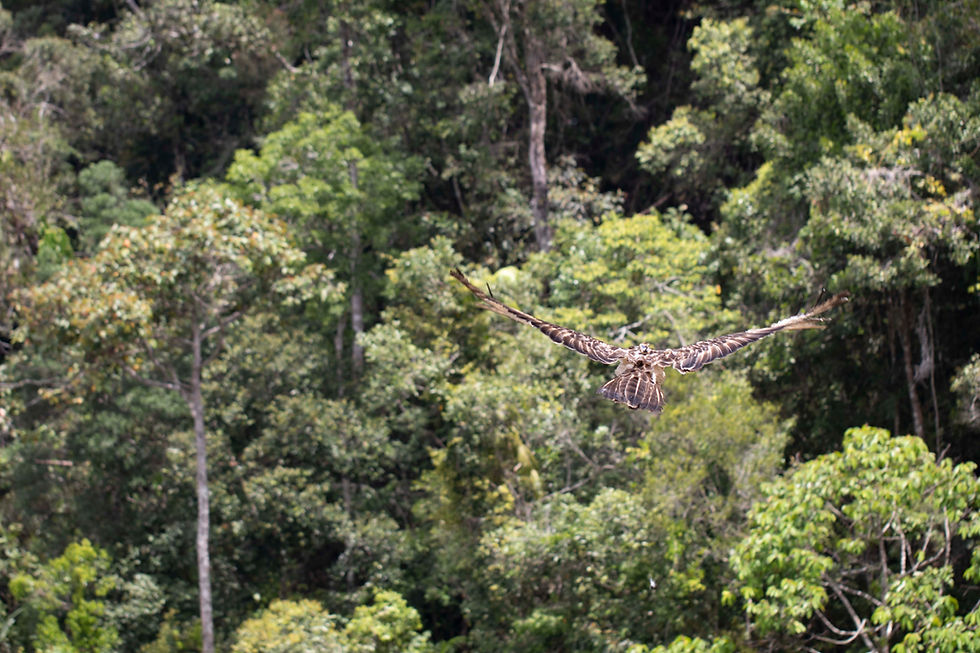
A native trap meant for deer and wild pig became the starting point of a much bigger conservation story in San Fernando, Bukidnon.
In October 2020, a young Philippine Eagle was accidentally caught in the mountains of Mt. Malimumu, Barangay Magkalungay. He was weak, underweight, and carrying an old pellet wound. After rescue and rehabilitation at the Philippine Eagle Center, he was released on Earth Day 2021 and named “Tagoyaman Fernando.”

His release happened during the pandemic, but the work around him quickly grew beyond one bird. PEF and its partners prepared communities for post-release monitoring and strengthened local support on the ground. Early tracking later showed that Tagoyaman Fernando moved north of the release site and settled within the forest interiors of San Fernando.
That early phase was strengthened by support from the Australian Embassy through a COVID emergency response grant. The support helped the Manobo Tigwahanon develop interim Indigenous plans, while women and youth groups prepared linked sub-plans of their own. It also supported food security and enterprise planning, together with webinars on COVID-19 and family safety, savings, gender and development, enterprise development, financial management, online selling, and other community needs.
The same support helped train, equip, and sustain Indigenous men and women as forest guards. That early investment became an important base for the larger conservation work that followed.
The Tigwahanon were also supported by the Center for Disaster Preparedness through its PINNOVATION Academy, which helped build a forest-based, culture-based approach to disaster risk reduction. Through the ALISTO Project, PEF and its partners trained Tigwahanon forest guards in disaster prevention, mitigation, preparedness, response, and recovery, while strengthening their role in forest protection. The work also helped the Tigwahanon codify their own community-based DRRM plan, using a framework that combined Indigenous knowledge, environmental governance, early warning, preparedness planning, emergency response, and post-disaster recovery.
San Fernando later became even more important as eagle habitat.
Close inspection of Tagoyaman Fernando’s latest GPS tracker readings shows a distinct territory that he may already be defending with a female partner. Now a sexually mature adult male, he may already have formed a pair bond with a monogamous mate.
In the same landscape, Sinabadan, a female Philippine Eagle that dispersed from Mt. Apo, settled in the adjacent mountains of Mt. Tangkulan and Mt. Agsamon. Monitoring in that area after Sinabadan was rescued in 2023 later confirmed a new resident eagle pair, while Mt. Agsamon also yielded documentation of an eagle family with a juvenile. The wider forests around these eagle sites are also rich in life. In the two Tigwahanon ancestral domains, recent surveys recorded hundreds of plant species, dozens of birds, and a strong mix of mammals, reptiles, and frogs, showing that San Fernando’s forests are supporting not only eagles, but a much larger web of wildlife across connected mountain habitats.

This changed the scale of the work.
What began with Tagoyaman Fernando’s rescue developed into a longer conservation effort supported by the LGU of San Fernando, the Manobo Tigwahanon communities, DENR, academia, and other partners. The focus expanded from rescue and release to habitat protection, community monitoring, local governance, and long-term management.
The USAID-funded SACRED Project helped organize this work through Indigenous governance support, biodiversity monitoring, community education, and conservation-based livelihoods. It supported CADT-related work, strengthened Indigenous Political Structures, trained forest guards, and expanded community-led conservation in the Northern Pantaron Range. The project also reported that the AgiLAYA campaign in San Fernando reached more than 500 participants, while community and mall-based events like the “Wildlife is Here” exhibit produced local commitments to protect eagle habitat and reforest community lands.
The Mandai-supported SACRED-NBS Project added another layer through SMART and KALUMBATA patrols, biodiversity monitoring, nursery establishment, forest restoration, and regenerative agroforestry. These projects also generated supplemental green-job income for Indigenous forest guards, local community organizers, Indigenous and local co-researchers, nursery technicians, agrotechnicians, and other community members involved in nursery, planting, and maintenance work. In practice, Indigenous partners were not only asked to protect the forest. They were also compensated for doing that work.
The network of support has continued to grow. Indigenous Tigwahanon leader Melchor Olowan Sr. joined eight other Indigenous leaders from Luzon and Mindanao in a four-week Australia Awards Fellowship in Australia hosted by Charles Darwin University. The fellowship connected Philippine Indigenous leaders with Aboriginal ranger groups and other partners in northern Australia, including exchanges on land management, habitat restoration, wildlife monitoring, and Indigenous-led enterprise.
Newer conservation investments are also being added. These include a current livelihood project with Catholic Relief Services (CRS) and the Darwin Initiative-supported project “Nature’s Neighbours: sustainable coexistence between indigenous people and Philippine eagles,” which includes work on ecological restoration, livelihood diversification, and ancestral domain rights.

Several concrete outcomes followed in San Fernando. The Tigwahanon declared their forests as an Indigenous Cultural Conservation Area, while Barangay Kibongcog’s forests were later declared a Local Conservation Area for carbon sequestration, wildlife protection, and Philippine Eagle conservation breeding. The LGU also committed incentives for forest guards assigned to monitor and protect these areas.
The work also produced direct benefits for communities living within eagle habitat. Women’s groups were supported through sewing, beadwork, and nursery-based livelihoods. Native tree nurseries were established and managed by local groups. Agroforestry plots were developed in San Fernando and nearby areas. A community-based water system was also installed in Sitio Inalay, Kibongcog, within the nesting territory of the eagle pair in Mt. Agsamon.
The same landscape has also produced other important biodiversity records. A 2025 publication reported a new distribution record of Rafflesia schadenbergiana in Mt. Sinayawan, Tangkulan Range, Barangay Kibongcog, San Fernando, adding another important record for the area’s biodiversity value.
Today, San Fernando stands as a landscape where Tagoyaman Fernando and a possible female mate, a new eagle pair where Sinabadan settled, and an eagle family documented in Mt. Agsamon are shaping a bigger conservation story. It is a story built on rescue, forest protection, Indigenous leadership, local government support, disaster resilience, and fair investment in community stewardship.
That is why San Fernando strongly reflects the Philippine Eagle Foundation’s Earth Day 2026 theme: “Saving Eagles, Protecting Forests, Securing our Future.” In San Fernando, that work is already underway.


What an incredible conservation story. It’s inspiring to see how one rescued Philippine Eagle became the starting point for broader habitat protection, Indigenous-led conservation, forest monitoring, and livelihood programs in San Fernando. I especially appreciate the focus on supporting local communities while protecting the forest, because long-term conservation really depends on people being part of the solution. The progress with Tagoyaman Fernando and the surrounding eagle habitat shows how sustained teamwork can create meaningful results. It’s a great example of how protecting natural resources and maintaining the systems communities rely on both require long-term care, something that EZ Flow NJ also values when it comes to dependable home services.
What an incredible conservation story. It’s inspiring to see how one rescued Philippine Eagle became the starting point for broader habitat protection, Indigenous-led conservation, forest monitoring, and livelihood programs in San Fernando. I especially appreciate the focus on supporting local communities while protecting the forest, because long-term conservation really depends on people being part of the solution. The progress with Tagoyaman Fernando and the surrounding eagle habitat shows how sustained teamwork can create meaningful results. It’s a great example of how protecting natural resources and maintaining the systems communities rely on both require long-term care, something that EZ Flow NJ also values when it comes to dependable home services.
La información incluida sobre MagisTV gratis me pareció bastante interesante. Estaba revisando diferentes recursos y este artículo destacó por su claridad. Los detalles están bien seleccionados y la explicación resulta natural, directa y fácil de comprender.
Thanks for this post. Girl games