


The Eagle That Changed a Hunter

How a wandering eagle, a stolen eaglet, and one Indigenous community reshaped the future of Philippine Eagle conservation
The first clue came from the sky.
Every few hours, a small GPS transmitter fixed to the back of a young Philippine Eagle sent another signal from somewhere in the mountains of Mindanao. Each point appeared like a faint heartbeat on a digital map. One location followed another, tracing a journey that few people had ever witnessed in such detail.
The eagle was named Sinabadan.
She had hatched in 2013 on the forested slopes of Mt. Apo, the highest mountain in the Philippines. For the first years of her life, she remained within her parents' territory, learning the ancient skills of her kind--how to ride the wind, how to hunt beneath the canopy, how to survive in a shrinking world.

Then, in 2017, she left.
For nearly three years, Sinabadan wandered across Mindanao. Her transmitter recorded her passage through forest corridors, river valleys, and rugged mountain ranges. She crossed landscapes stitched together by old-growth trees, farms, Indigenous territories, logging roads, and remote communities. Somewhere beyond the maps and beyond the reach of most conservation patrols, she was searching for what every young Philippine Eagle must eventually find: a territory of her own.
Then, in 2020, the wandering stopped.
The signals began to cluster in the forested mountains of San Fernando, Bukidnon, more than 100 kilometers from the nest where Sinabadan had hatched. She had reached the Tangkulan Mountain Ranges, a vast and biologically important landscape within the Tigwahanon Ancestral Domain. To conservation biologists of the Philippine Eagle Foundation, or PEF, the pattern was unmistakable. Sinabadan had found a place to settle.
![One year old Sinabadan in 2014. Antenna of her first satellite GPS tracker sticking out from her back. [Photo by Lory Tan]](https://static.wixstatic.com/media/d08c94_3ecf653370054b838a63a68b0ed2b3eb~mv2.jpg/v1/fill/w_980,h_653,al_c,q_85,usm_0.66_1.00_0.01,enc_avif,quality_auto/d08c94_3ecf653370054b838a63a68b0ed2b3eb~mv2.jpg)
For the Foundation, her journey opened a new frontier.
If Sinabadan had established a territory, she would soon need a mate, a nesting area, and a safe forest where she could raise young. Protecting her would require more than maps and transmitters. It would require trust. It would require people who knew the forest not as a study site, but as home.

PEF began working with Manobo-Tigwahanon communities in the remote villages of San Fernando. The Foundation met with Indigenous leaders and local residents to explain the significance of Sinabadan's presence and to build a conservation partnership rooted in shared responsibility. Skilled hunters and experienced trail masters were recruited as community forest guards.

Their knowledge was extraordinary.
They knew where trails disappeared under leaf litter. They could read animal signs on the ground, recognize distant calls, and move through steep forest terrain with ease. What scientists brought in equipment and methods, the community brought in memory, instinct, and generations of lived experience.
Together, they monitored Sinabadan's movements, searched for signs of other eagles, guided research teams, and patrolled the ancient forests. The forest guards received patrol fees and food allowances for their work. One of their tasks was to help PEF attempt to retrap Sinabadan so her aging GPS transmitter could be replaced before its battery failed.
Word of the work spread quickly through the uplands.
People heard that local residents were being paid because of Philippine Eagles.
But as the story moved from one village to another, its meaning changed.
One man misunderstood it completely.
He was known simply as Dodong.
That was not his real name. It is used here to protect his identity.
Among the forest interiors of San Fernando, Dodong was known as a skilled hunter. Like many Indigenous hunters, he had spent much of his life in the mountains. He knew the hidden routes, the fruiting trees, the animal trails, and the quiet places where wildlife passed. His knowledge was not learned from books. It was shaped by hunger, hardship, and a lifetime of moving through the forest.
When Dodong heard that people were being paid in connection with Philippine Eagles, he believed he had found a rare chance to earn money for his family.
He thought people were being paid to trap eagles.
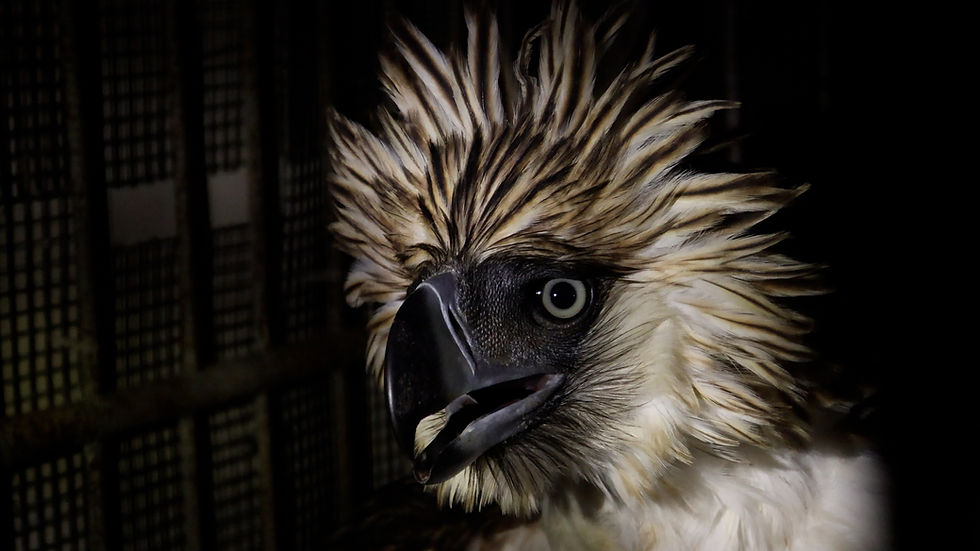
So he climbed a towering nest tree that he had known for years. Inside was a Philippine Eagle chick, only two to three months old. Small for an eagle that would one day rule the canopy, but already carrying the fierce gaze of its species, the chick was still completely dependent on its parents.
Dodong carefully removed the eaglet from the nest and carried it home.
His intention was simple.
He would sell it to the Philippine Eagle Foundation.
Instead, the Foundation came to him.
After local residents reported the captive eagle, a response team was organized. PEF biologists and veterinarians, personnel from CENRO Valencia, the Municipal Environment and Natural Resources Office of San Fernando, and Indigenous leaders travelled through the night to reach the remote village of Barangay Kibongkog.
There, they met Dodong.
The situation could easily have become confrontational. The Philippine Eagle is one of the rarest and most threatened birds of prey in the world, and Philippine law prohibits the capture, possession, or harm of endangered wildlife. But the people who came to Barangay Kibongkog understood that the future of the eagle could not be secured through fear alone.

They chose dialogue.
For hours, they spoke with Dodong respectfully. They explained the importance of the eaglet, the danger of removing it from the wild, and the purpose of PEF's work in the area. Eventually, Dodong agreed to surrender the chick so it could receive urgent veterinary care.
The eaglet was stabilized in the field, then transported overnight to the Philippine Eagle Center in Davao City. There, veterinarians examined her carefully.
Remarkably, she had survived.
She had no fractures. No serious injuries. Against the odds, the young eagle had come through the ordeal alive.
She was named Agsamon, after the mountain where she was born.
In the days that followed, PEF continued speaking with Dodong. The Foundation explained that it never pays people for capturing Philippine Eagles. The payments he had heard about were for protecting them.
Community forest guards were compensated for patrolling eagle habitats, monitoring movements, protecting nests, and assisting scientific research. They were paid not to remove wildlife from the forest, but to help keep it there.

Dodong was surprised.
In his remote village, formal education, conservation outreach, and government services had long been limited. Hunting was part of daily life, not because people wanted to destroy wildlife, but because poverty, isolation, and a lack of alternatives shaped the choices available to them. In many upland communities, laws protecting endangered species exist on paper long before conservation support reaches the people expected to follow them.
PEF faced a choice.
Dodong could be treated only as an offender. Or he could be reached as a person whose knowledge, once redirected, could help protect the very species he had harmed.
The Foundation chose the second path.
Dodong was invited to join the same conservation program he had once misunderstood.
Over time, he received training and became one of PEF's community forest guards. The skills that had once made him an accomplished hunter--his patience, his sharp eye, his ability to read the forest, his courage in difficult terrain--became the very skills needed to protect Philippine Eagles.
Dodong helped patrol eagle habitat. He reports illegal activities. He monitors wildlife. He helps safeguard active nesting territories.
The man who once climbed an eagle nest now climbs mountains to make sure no one else does the same.
Because she had been taken from the wild when she was only two to three months old, she missed a critical stage in a young eagle's life. Philippine Eagle chicks spend many months under the care of their parents. During that time, they learn how to balance on branches, strengthen their wings, recognize danger, hunt, and survive in the forest.
Agsamon had lost that chance.
Returning her to the wild was no longer possible.
Instead, she became part of the Philippine Eagle Foundation's assurance population--the carefully managed group of Philippine Eagles under human care that serves as a genetic safeguard against extinction. For a species with so few individuals left, every eagle matters. Every bloodline matters. Every surviving bird may carry something essential for the future.
Years later, scientists made an important discovery.
Comprehensive genomic analyses revealed that Agsamon carries a rare and distinct genetic lineage. Her ancestry represents diversity that is poorly represented in the existing captive population. In conservation breeding, such diversity is precious. It can help strengthen the long-term health, adaptability, and resilience of future generations.
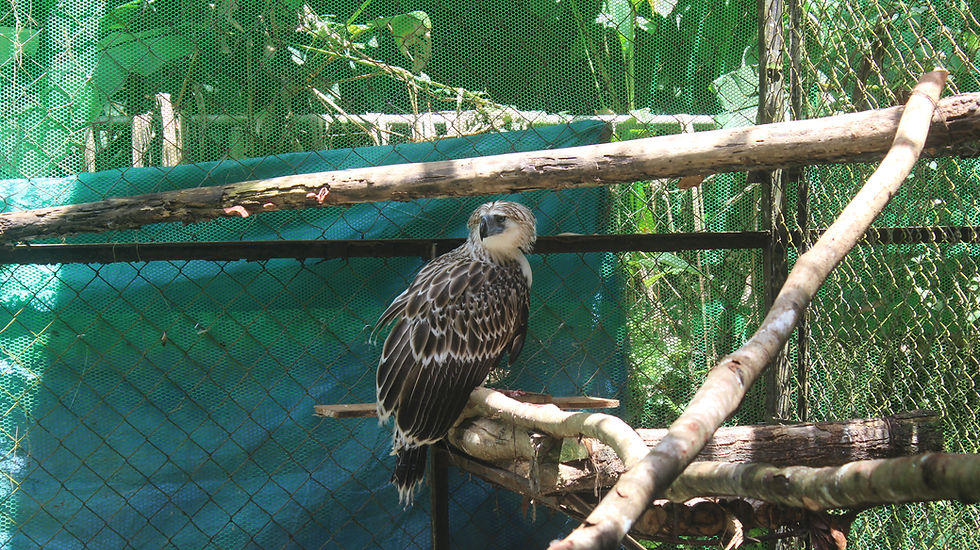
Agsamon, the eaglet once taken from a nest in a remote mountain forest, had become one of the most genetically valuable Philippine Eagles under human care.
Today, she is being carefully trained for PEF's cooperative artificial insemination program. She may never fly again above the forests of Mt. Agsamon. She may never ride the wind across the Pantaron range. But one day, she may become the mother of eagles that will.
In the mountains, the work continued.
The rescue of Agsamon deepened the partnership among PEF, the Manobo-Tigwahanon community, Indigenous leaders, local government units, and community forest guards. What began with the tracking of Sinabadan became a wider effort to protect breeding habitat, strengthen forest patrols, document Indigenous ecological knowledge, and build community-based conservation in one of Mindanao's most important eagle landscapes.
Then, in 2023, PEF researchers returned to Mt. Agsamon.
Together with community forest guards and Manobo-Tigwahanon partners, they searched the area to find out whether the resident eagle pair had nested again. For eight days, the team surveyed the forest, watching the ridges, listening for calls, and following signs of eagle activity.
Then the forest answered.
The team documented repeated activity by the resident adult pair. And then, remarkably, they saw another juvenile Philippine Eagle flying within the same nesting territory where Agsamon had once been taken.
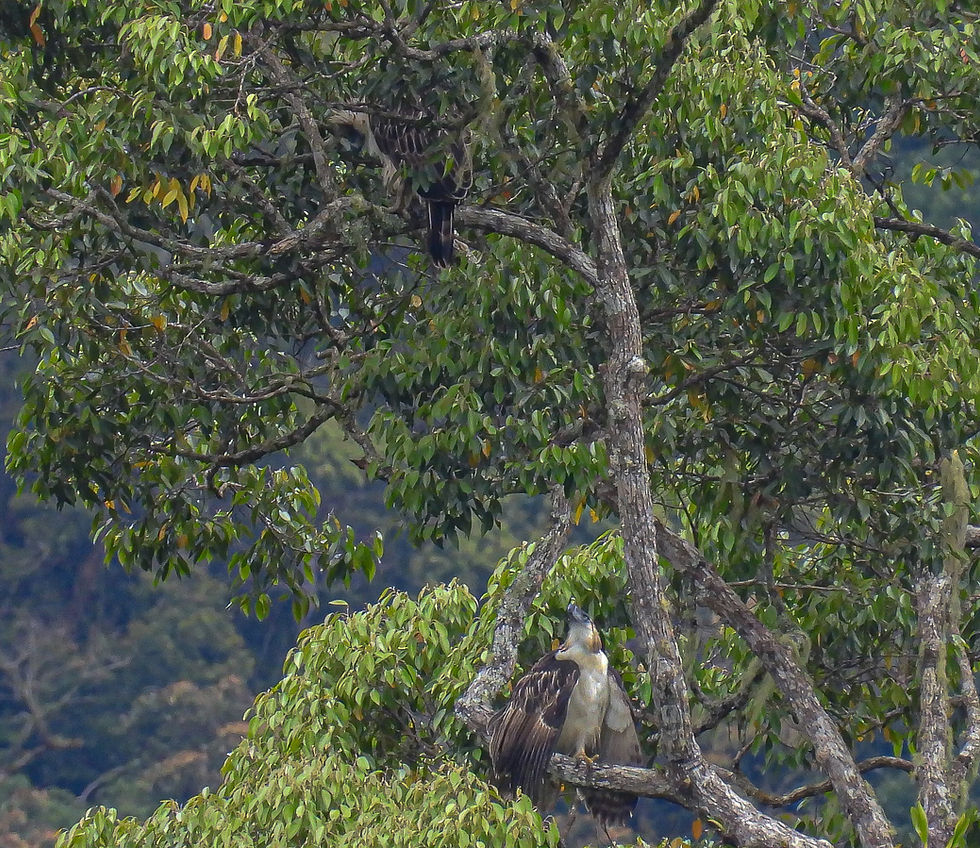
The pair had raised another chick.
It was a powerful confirmation. The territory was still alive. The forest was still producing eagles. And with sustained protection, the next generation had been given a chance to survive in the wild.

The story of Agsamon is not only the story of a rescued eaglet.
It is the story of Sinabadan, the wandering eagle whose GPS signals led conservationists into a new landscape.
It is the story of an Indigenous community whose knowledge became central to protecting one of the world's rarest raptors.
It is the story of Dodong, a hunter who misunderstood conservation, then became one of its defenders.
It is the story of a young eagle that could never return to the wild, yet may still help secure the future of her species through conservation breeding.
Forest Guards and Kibongcog community leaders with PEF Team and SCENE Coalition partners from Singapore, Indonesia and Malaysia.
Above all, it is a story about what conservation requires.
It requires science, but not science alone. It requires laws, but not laws alone. It requires forests, but also the trust of the people who live beside them.
In the mountains of San Fernando, a wandering eagle led people to a hidden territory. A stolen eaglet revealed a deeper need for understanding. And a hunter, once known for taking from the forest, found a new purpose in protecting it.

Sometimes, the greatest victory in conservation is not only saving an endangered animal. Sometimes, it is changing the heart of the person who will protect the next one.


Stories that connect wildlife conservation with personal change can offer a powerful perspective on protecting the Philippine Eagle. For field observations and conservation notes recorded by hand, convert handwritten images to text can help preserve and organize valuable information.
Для регулярного поиска полезной информации можно использовать https://lifehata.com.ua/ru/, где представлены статьи о ситуациях, с которыми люди сталкиваются в обычной жизни. Разнообразие тем делает ресурс удобным для повторных посещений.
Ресурс https://infosaray.com.ua містить публікації для широкого кола читачів. Тут можна натрапити як на практичні поради, так і на пізнавальні статті.
This guide caught my attention because the information was presented in a straightforward and reader-friendly manner. The introduction gave enough background before moving into more detailed sections. During the main discussion, Singham Lottery app appeared naturally while explaining one of the important aspects of the topic. Each paragraph added something different, which helped keep the article engaging throughout. Before the final section, Singham Lottery app was mentioned again while connecting the important ideas discussed earlier. Overall, the article was clear, organized, and easy to understand without unnecessary filler.
This story really touched me! It’s amazing how the eagle transformed the hunter's perspective. Makes you reflect on the beauty of nature and spider solitaire free second chances. Thanks for sharing this powerful narrative!