


Princess Maasim: From Near Tragedy to Conservation Legacy

A Bird in the Sea
The sea is no place for a Philippine Eagle.
Yet one day in November 1993, off the coast of Maasim in Sarangani, a young eagle was found struggling on the water. She was built for the high forests of Mt Busa —for its ridgelines, giant trees, and warm columns of air rising from the land. Her wings were made to carry her above the mountain, not waves.
But there she was: soaked, exhausted, and close to death.
Then fishermen saw her. They pulled the young eagle from the sea and gave her a second chance at life. No one could have known that this rescue would echo across decades. What began as a near tragedy would become one of the most meaningful stories in Philippine Eagle conservation.
She would first be known as Princess Maasim. Today, she is known as LDI.
A Young Eagle’s Risk
LDI was only about two years old when she was rescued—a juvenile at one of the most vulnerable stages of an eagle’s life. Young Philippine Eagles eventually leave their parents’ territories and search for their own place in the forest. For a soaring bird, air is both pathway and risk. Over land, warm air can lift an eagle across ridges. Over open water, that support disappears. A young bird that drifts too far from land can tire, lose lift, and fall.
LDI survived that edge.
Her rescue brought her into the care of the Philippine Eagle Foundation and eventually to the Philippine Eagle Center in Malagos, Davao City. There, she became more than a rescued bird. She became part of the conservation breeding program—a living genetic resource for one of the rarest and most threatened eagles in the world.

Why One Eagle Matters
The Philippine Eagle is both national bird and measure of forest health. To support one breeding pair, a landscape must still have enough forest, prey, nesting trees, and protection from disturbance. The species also breeds slowly, so every rescued eagle, fertile egg, and surviving chick represents years of care, science, patience, and hope.
Tsai and LDI
At the Philippine Eagle Center, LDI was paired with Tsai, a male Philippine Eagle who became one of the most important birds in the breeding program. Together, they became one of the program’s most productive natural pairs.
Their courtship was described in almost romantic terms: courtship feeding, where the male offered food to the female; mutual preening of each other’s feathers; nest-building together; and repeated bonding behaviors that eventually led to successful breeding.
From that bond came a remarkable line of offspring: Gloria Victoria, Chick 17, Dakila, Hineleban, Pin-pin, Bighani, and Chick 23. Chick 23 would later become known as Viggo.
The Chick That Tested the Future
In 2010, Chick 23 hatched after a difficult emergence from the egg. He was small, fragile, and carefully reared under methods designed to limit human imprinting. Caretakers used an eagle puppet when feeding him, allowing the young bird to respond to the image of his own kind instead of people.

Every detail mattered. Every feeding served a larger goal: to raise a captive-bred Philippine Eagle that might one day survive in the wild. That hope followed him into the mountains.
In 2011, Chick 23 was reintroduced to the wild in Mt. Kitanglad, Bukidnon. It was a bold test of whether captive-bred Philippine Eagles could fly, hunt, avoid danger, and live as wild eagles.
For a time, Chick 23 showed promise. His flight and survival skills improved. He moved through forest habitat and began testing the instincts protected during his rearing.
But the release also revealed a serious risk. Chick 23 remained too comfortable around people. He showed tame behavior and was too trusting of humans. For a Philippine Eagle, that trust can be fatal. A bird that does not fear people may approach farms, perch near houses, or remain close to communities. In risky landscapes, tameness is not innocence. It is danger.
The team brought him back into captivity permanently.
His return was not simply a failed release. It was a turning point. The test showed that captive-bred eagles could develop important survival skills, but also that future release candidates must remain wary of people.
That lesson helped overhaul and refine the chick-rearing program for captive-bred Philippine Eagles intended for future release. It strengthened the need to reduce human exposure, improve behavioral conditioning, and protect wildness.
In this way, LDI’s legacy is not only counted in offspring. It is also written into better breeding and rearing protocols for the future.
Viggo: The Eagle on the Bill
Years later, Chick 23 became one of the most recognizable Philippine Eagles in the country. He became Viggo.
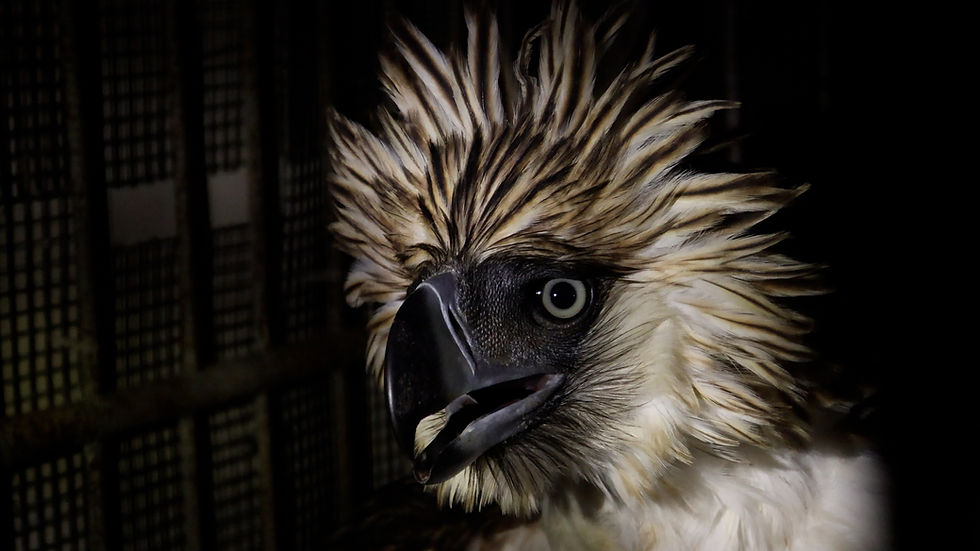
His image was used as the model for the Philippine Eagle portrait on the ₱1,000 polymer banknote. For millions of Filipinos, that bill became their closest everyday encounter with the national bird: a fierce gaze, a powerful beak, and a crest like a crown.

But behind that image is a real eagle. Behind that eagle is a bloodline. And behind that bloodline is LDI—the young bird once pulled from the sea by fishermen.
Through Viggo, LDI helped produce the nation’s latest poster eagle.
More Than a Symbol
Viggo’s importance does not end with his image on the nation’s currency.

Apart from becoming the country’s latest poster eagle, Viggo is also a potential semen donor for future cooperative artificial breeding efforts. His semen is now being used to inseminate Mabuhay, the sole offspring of the iconic Pag-asa—the first Philippine Eagle ever bred and hatched in captivity at the Philippine Eagle Center.
This links LDI’s bloodline with the historic line of Pag-asa, whose birth in 1992 marked a breakthrough in Philippine Eagle conservation breeding.
In Viggo, LDI’s legacy is both public and practical: seen by the nation on the ₱1,000 bill, and carried forward in the breeding program.
Dakila’s Line
LDI’s legacy did not stop with Viggo.
Another of her offspring, Dakila, became part of the conservation breeding line. Dakila represents a quieter but equally important branch of LDI’s contribution. If Viggo carried the Philippine Eagle into national visibility, Dakila carried the line forward inside the breeding program itself.

Dakila later became the mother of Bayani, the Philippine Eagle Foundation’s newest captive-bred chick announced in 2026. Bayani, produced through cooperative artificial insemination, is the offspring of Dakila and Sinag.
This makes Bayani part of LDI’s continuing conservation chain: from a rescued juvenile at sea, to a breeding female in captivity, to Dakila, and then to a new chick representing another generation of hope. In family terms, LDI is Bayani’s grandmother—a rescued eagle whose legacy now lives on through her grandchild.

Three Branches of Legacy
LDI’s legacy now has three powerful branches.
One is Viggo, the eagle whose image now moves through the country on the ₱1,000 bill, reminding Filipinos of the national bird and the forests it represents. He is also a potential semen donor for future cooperative artificial breeding efforts.
Another is Dakila, whose role in the breeding line helped produce Bayani, extending LDI’s genetic contribution into a new generation.
The third is the lesson of Chick 23’s release: a test that helped refine how captive-bred eagles must be raised if they are ever to return safely to the wild.
One descendant became a national symbol. Another became a bridge to the future. And one difficult experiment helped improve the science behind future releases.
Together, they show why rescue, rehabilitation, conservation breeding, and adaptive management matter. A bird saved from drowning did not simply survive. She became part of a living lineage that now reaches the public through Viggo, the breeding program through Dakila and Bayani, and the future of release work through the lessons of Mt. Kitanglad.
The Forest Remains the Goal
LDI’s story is powerful, but it is not a simple triumph. A Philippine Eagle belongs in the wild, above forested ridges, within a territory large enough to hunt, nest, and raise young. Captivity is not the dream. It is the safety net for birds that cannot return safely to the wild.
The true goal remains the forest.
Every captive-bred chick carries hope, but hope alone cannot save the species. Philippine Eagles still need protected habitats, safe nesting territories, informed communities, trained forest guards, and landscapes where young birds can disperse safely.
LDI’s story begins with rescue, but it points toward prevention: safer forests, stronger communities, better monitoring, and better-prepared birds for any future release.
The Rescue That Still Echoes
The first heroes in LDI’s story were not scientists, veterinarians, or wildlife managers. They were fishermen who saw a struggling eagle in the water and chose to act.
Their decision gave one bird a future. That future gave conservationists a breeding female. That breeding female gave the country Viggo, the eagle on the ₱1,000 bill. She gave the breeding program Dakila’s line, and through Dakila, Bayani. She also gave conservationists hard lessons from Chick 23’s release—lessons that now help shape the rearing of captive-bred Philippine Eagles for the future.
From the sea, LDI was lifted back into life.
From that life came descendants, knowledge, and hope.
Her story began as a near tragedy. It became a conservation legacy—one rescued eagle’s life carried forward in symbols, science, offspring, and the continuing fight to save the Philippine Eagle.


This post caught my attention because the information is organized in a way that feels natural and reader-friendly. I continued exploring the subject and found jaya 9 as another related resource. It can be useful to have different sources when learning about an unfamiliar online topic.
RR888 Tôi bắt đầu trải nghiệm từ khu vực thể thao vì muốn kiểm tra cách nhiều môn được tập trung trên cùng một nền tảng. Tôi lần lượt mở bóng đá, bóng rổ, tennis và đua xe, sau đó xem các thông tin như kèo châu Á, châu Âu, tài xỉu, thẻ phạt và phạt góc. Nếu chuyển từ môn này sang môn khác mà vẫn có thể nhanh chóng nhận biết danh mục và nội dung đang xem, quá trình theo dõi sẽ thuận tiện hơn. Tôi tiếp tục kiểm tra những trận đang diễn ra để xem phần thể thao trực tiếp được trình bày như thế nào. Ngoài ra, tôi chú ý đến các nhà cung cấp…
A vacuum cleaner is a great product!
8XBET khiến mình để ý đến sự thay đổi trong cách trình bày khi mình sử dụng ở những màn hình khác nhau. Mình thường quan sát một lượt trước khi thao tác để xem các phần quen thuộc được đặt ở đâu. Khi muốn chuyển từ Blackjack sang Mậu Binh trên điện thoại, mình chú ý cách nội dung được thu gọn và thứ tự các thành phần sau khi không gian hiển thị nhỏ hơn. Mình không cần bố cục giống hoàn toàn với máy tính, miễn những điểm chính vẫn dễ nhận diện. Sau khi quen cách sắp xếp, mình thấy việc đổi thiết bị ít ảnh hưởng đến thói quen tìm kiếm vì vẫn có những dấu…
https://gg88.tv/ là nơi tôi thử quan sát riêng cách nền tảng hướng người dùng đến các kênh hỗ trợ. Tôi tìm live chat, Telegram, email và hotline từ những vị trí khác nhau trên giao diện để xem mức độ dễ nhận biết. Sau đó, tôi đối chiếu mục đích của từng kênh với tình huống sử dụng: câu hỏi nhanh, vấn đề cần mô tả chi tiết hay trường hợp cần trao đổi trực tiếp. Tôi cũng chú ý xem thông tin liên hệ có được trình bày thống nhất hay phải tìm qua nhiều trang. Với tôi, khả năng tiếp cận hỗ trợ không chỉ nằm ở việc có nhiều kênh mà còn ở cách người dùng nhận ra…