


Discovery of the Elusive Mindanao Bleeding-Heart in Mt. Hilong-Hilong KBA, Surigao del Norte
- Feb 11
- 4 min read
by: Gerald Regondola

In the rugged karst forests of Surigao del Norte, where steep slopes and sharp limestone formations make fieldwork demanding and high risk, an important conservation record was recently achieved. After weeks of surveys, the Mindanao Bleeding-heart was documented through camera trapping in the Mt. Hilong-Hilong Key Biodiversity Area in December 2025. This record provides strong evidence that the remaining forest habitat in this landscape continues to support threatened wildlife, despite increasing pressures in many parts of Mindanao.
The Mindanao Bleeding-heart (Gallicolumba crinigera crinigera) is a forest dove found only in the southern Philippines, with recorded presence in Mindanao, Basilan, and the Dinagat Islands. It is widely recognized by wildlife researchers as one of the most difficult forest birds to detect. This difficulty is mainly due to its behavior in which it spends much of its time moving quietly on the forest floor under thick vegetation. It seldom enters open areas, and when disturbed, it typically flees by running into cover or taking short bursts of flight. These traits make direct sightings uncommon even in forests where the species still persists.

To address this challenge, the survey used camera trapping, a wildlife monitoring method that documents animals with minimal disturbance. Motion-activated cameras were installed close to the ground in strategic locations where forest-floor birds are most likely to pass while feeding or moving between areas of cover. These devices operate continuously, day and night, and automatically record photos or short videos when movement triggers the sensor. For shy and ground-dwelling species such as the Mindanao Bleeding-heart, camera traps are especially useful because they can detect wildlife that observers may not see during standard walks.
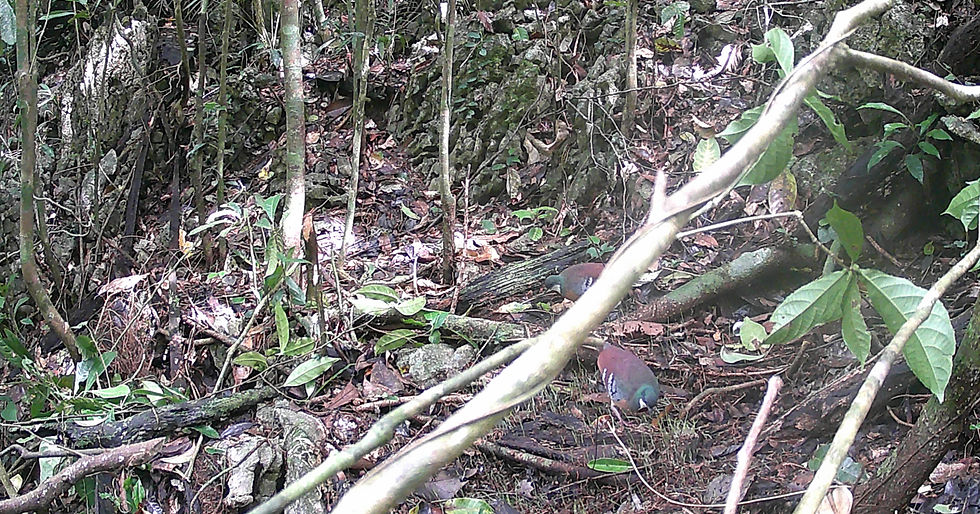
Survey teams worked under difficult field conditions that required crossing rivers, navigating steep and uneven limestone terrain, and conducting regular checks in remote areas where access is limited. The team obtained a clear camera trap record of the Mindanao Bleeding-heart. On the following day, the bird returned to the same area accompanied by a partner. This repeat detection is important because it confirms the presence of a pair and suggests that the site is not only used as a temporary route, but may also provide suitable feeding areas and shelter that support regular use by the species.
For local communities and forest managers, the meaning of this finding can be explained in practical terms. When a sensitive forest species like the Mindanao Bleeding-heart is confirmed in an area, it often indicates that the forest still provides essential conditions for wildlife survival. These conditions include a healthy layer of leaf litter where food is found, sufficient vegetation cover for protection, and an intact forest structure that supports many small plants and animals that form the foundation of the ecosystem.
The Mindanao Bleeding-heart feeds on the forest floor by searching through leaf litter for fallen berries, seeds, worms, and insects. Because it depends on dense cover for safety, it becomes highly vulnerable when forests are cleared, thinned, or opened. Habitat loss removes the protective vegetation that allows the bird to feed and move without being easily detected. This exposure also increases vulnerability to hunting and trapping, which remain significant threats in some areas.

The Mindanao Bleeding-heart is currently classified as Vulnerable. Major threats include habitat loss from deforestation and forest conversion, as well as hunting and trapping. As remaining forest patches become smaller and more isolated, each confirmed location where the species still persists becomes increasingly important for conservation planning and long-term protection. During retrieval of camera traps in January 2025, another pair was documented in the same landscape. This second record was located about 1.75 kilometers away in air distance from the first pair. Together, these findings strengthen evidence that the Mt. Hilong-Hilong KBA continues to provide habitat that can support this species.
The confirmed presence of the Mindanao Bleeding-heart in Mt. Hilong-Hilong KBA is a clear reminder that these forests still contain wildlife found nowhere else. It also highlights an important point for the wider public. The same forest that shelters rare species also supports ecosystem services that people depend on, including clean water, stable slopes that reduce erosion and landslide risk, and natural resources used by communities in daily life. Protecting and monitoring these forests helps ensure that both wildlife and people continue to benefit from a healthy landscape.

This documentation was made possible through coordinated work across institutions and local partners operating in the same landscape with a shared conservation purpose. The contributions of the Philippine Eagle Foundation, PENRO Surigao del Norte, LGU-MENRO, and LGU-DENRO were essential in enabling field surveys, site access coordination, and on-ground monitoring support.
This initiative is part of the DENR-UNDP/GEF project on “Integrated Approach in the Management of Major Biodiversity Corridors in the Philippines” or BD Corridor Project, which seeks to operationalize integrated management of biodiversity corridors to generate multiple benefits, including effective conservation of globally threatened species and high conservation value forests, reduce deforestation and degradation, and enhance local biodiversity-friendly livelihoods. The project is implemented by the Department of Environment and Natural Resources in partnership with the United Nations Development Programme and funded by the Global Environment Facility. To reduce risk to the IUCN-listed Vulnerable Mindanao Bleeding-heart, the exact location of this observation is intentionally not being shared in public communications.


Throughout history, pocket watches have reflected the fashion and craftsmanship of their time. Designs inspired by the Victorian, Edwardian, and Art Deco periods continue to attract collectors and enthusiasts today. A Vintage Pocket Watch often features elegant engravings, detailed dials, and traditional mechanical movements that showcase timeless artistry. These pieces are valued not only for telling time but also for their historical character and visual appeal. Whether displayed in a collection or worn as an accessory, classic pocket watch styles offer a connection to past eras while maintaining lasting charm and sophistication.
If you continue to sprint for a longer period of time, the speed of the game subway surfers will quicken. Despite the fact that the speed is rapidly increasing and new obstacles are appearing on the courses, you should maintain your concentration and master the run. You are eliminated from the game if you either crash or are caught by the Inspector.
What a remarkable and deeply moving discovery — the confirmation of the Mindanao Bleeding-heart in Mt. Hilong-Hilong KBA is the kind of conservation news that genuinely restores hope. The fact that a pair returned to the same location the very next day tells such a powerful story about habitat dependency and why protecting these forests is so urgent. Stories like this deserve to be heard far beyond the scientific community, and they'd make genuinely compelling higher english discursive essay topics for students exploring biodiversity loss, habitat destruction, or the ethics of wildlife conservation. The meticulous camera trapping methodology and cross-institutional collaboration here are also inspiring — it's the sort of well-documented fieldwork that New Assignment Help UK often encourages students…
Got into Block Blast recently and it scratches that same itch as Tetris but with its own twist. The block-fitting mechanic is simple to pick up but getting high scores takes some actual strategy. Good for short sessions when you have a few minutes to kill.
Many children love dolls because they bring stories to life. A doll can become a friend, a student in a pretend class, or a hero on a tiny adventure. Playing with dolls helps kids practice care, sharing, and imagination. On toy websites, parents often read short guides and Click through photos to see size, clothes, and details before buying. Simple fabric dolls, wooden dolls, or modern fashion dolls all offer fun moments. Through daily play, a small doll can inspire kindness, creativity, and joyful storytelling at home every day together.