


From Cage to Canopy: Lakpue’s Second Chance at Freedom
Annie Marsha P. Abayan

Behind the cyclone-wire mesh of his enclosure, Lakpue watched the world he was born to rule—but could never reach.
For 22 years, that world remained just beyond the wire.
Every morning, food arrived on time. Wildlife keepers checked on his health. Veterinarians treated him whenever he was sick. He was safe—but he was never free.
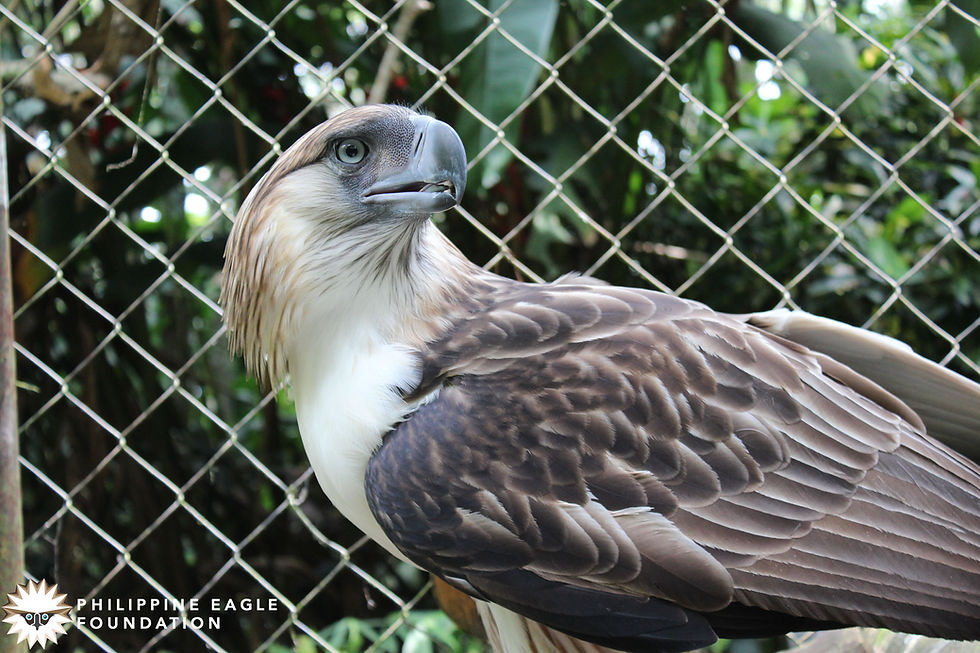
Then, on a quiet morning in the forests of Leyte, a door swung open.
For a few long moments, the Philippine Eagle hesitated. Beyond the cage was something he had never truly experienced: towering rainforest, endless treetops, unfamiliar sounds, wild prey, and freedom.
With a powerful beat of his wings, Lakpue launched into the air.
It was the first flight of a new life.
Lakpue’s story began more than two decades earlier.

He was only about two months old when he was rescued from the wild. Too young to survive on his own, he was brought to the Philippine Eagle Center in Davao City, where wildlife experts from the Philippine Eagle Foundation raised him with one hope—that one day he might return to the forests where Philippine Eagles belong.
Year after year, Lakpue remained in captivity. While wild Philippine Eagles soared across vast mountain forests and hunted beneath towering canopies, he spent his life inside an enclosure. Behind the cyclone-wire mesh, the forest existed only as something to watch from a distance.
Yet his keepers never stopped believing that the opportunity for freedom might one day come.
That opportunity finally arrived in 2025.
On March 21, Lakpue left Davao and journeyed to Barangay Kagbana in Burauen, Leyte, where the Philippine Eagle Foundation is working to restore the country’s national bird to parts of its former range.
But releasing an eagle that had spent 22 years in captivity could never be rushed.
For the next six months, Lakpue lived inside specially designed forest aviaries overlooking the rainforest that would soon become his home. From within the enclosure, he watched the forest awaken each day. He listened to birds calling through the canopy, watched wildlife moving beneath the trees, and slowly became familiar with the changing weather, scents, sounds, and rhythms of Leyte’s forests.
While Lakpue adjusted, an entire team quietly prepared for the moment everyone had been waiting for.
Biologists carefully monitored his behavior. Veterinarians assessed his health. Field technicians maintained the release site. Forest guards protected the surrounding habitat. Personnel from the Department of Environment and Natural Resources worked alongside volunteers and the people of Barangay Kagbana, whose support became an essential part of Lakpue’s journey home.

Every observation, every successful behavioral milestone, and every sign of growing confidence brought him one step closer to freedom.
Before his release, Lakpue underwent a comprehensive veterinary examination. He was fitted with a lightweight GPS tracker and radio transmitter, allowing scientists to monitor his movements and well-being as he adjusted to life in the wild.
At the same time, the Philippine Eagle Foundation carried out Community Education and Public Awareness (CEPA) activities in nearby communities, helping residents understand Lakpue’s return and encouraging people to become partners in protecting both the eagle and the forests he depends on.

Finally, on September 30, 2025, everything was ready.
The cage door opened.
Lakpue stepped into the forest—not as a bird in captivity, but as a wild Philippine Eagle.
His first weeks were cautious.
He stayed close to the release site, making short flights before gradually exploring farther into the forest. Every day brought new lessons. He had to find safe roosts, learn the landscape, recognize threats, and most importantly, hunt for himself.
The riparian forests along the Marabong River soon became one of Lakpue’s favorite hunting grounds.
There, the river carved its way through dense forest, creating ideal habitat for the large reptiles that Philippine Eagles are known to hunt. Monitoring teams frequently observed Lakpue patrolling the river corridor, apparently searching for unsuspecting monitor lizards and Philippine sailfin lizards basking in the morning sun or resting quietly on rocks and along the riverbanks. Patient and deliberate, he watched from elevated perches before launching swift, powerful attacks.
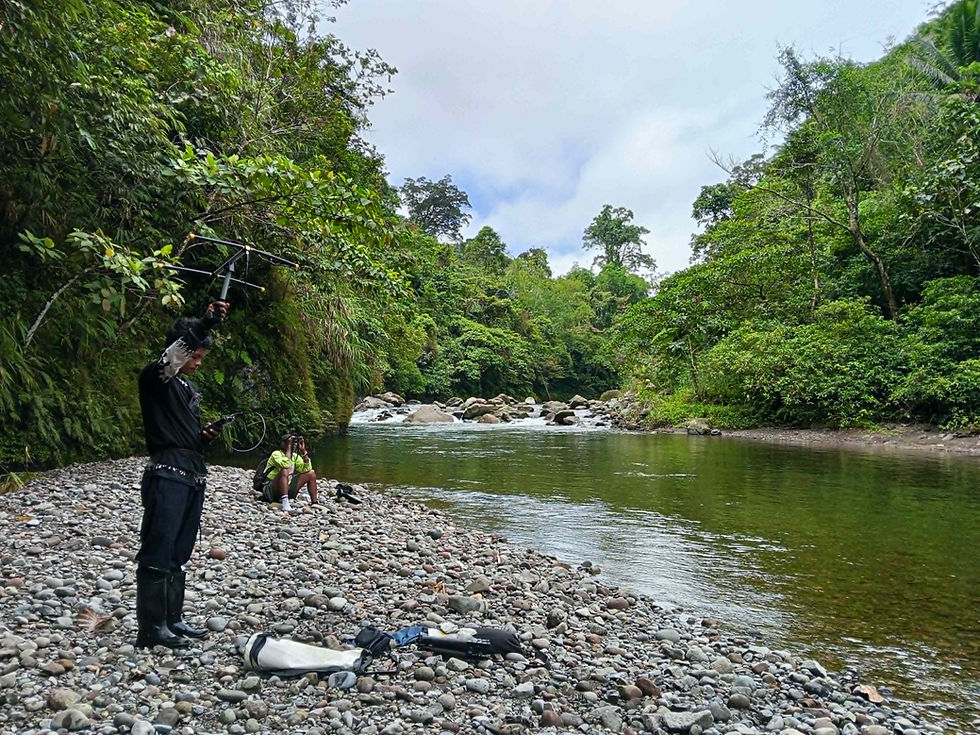
Like wild Philippine Eagles, Lakpue also learned to search the forest canopy and hidden tree crevices for sleeping Asian palm civets. On other occasions, he pursued snakes through the forest—including the venomous Samar cobra—demonstrating remarkable confidence and precision as he mastered one of the forest’s most dangerous prey.
His growing hunting repertoire tells an extraordinary story.
Field teams documented Lakpue successfully capturing Philippine sailfin lizards, monitor lizards, Asian palm civets, and Samar cobras. The diversity of his prey reveals.

Field teams documented Lakpue successfully capturing Philippine sailfin lizards, monitor lizards, Asian palm civets, and Samar cobras. The diversity of his prey reveals far more than an ability to survive. It shows that Lakpue has learned multiple hunting strategies and is exploiting different parts of the forest—from riverbanks and rocky streams to towering canopies and dense undergrowth—just as wild Philippine Eagles do.
For an eagle that spent more than two decades behind the bars of an enclosure, the transformation has been remarkable.
Today, Lakpue is no longer simply surviving in the forests of Leyte. He has become a skilled apex predator, confidently reclaiming the ecological role his species has played in Philippine forests for thousands of years.
The forest, in turn, has accepted its newest resident.
Lakpue has been mobbed several times by other birds of prey, including South Philippine Hawk-Eagles and Brahminy Kites. To casual observers, these encounters might appear hostile. But for wildlife biologists, they are a reassuring sign. Territorial disputes are part of everyday life for wild raptors.

For the first time in his life, Lakpue was no longer isolated from nature.
He was becoming part of it.
Today, every flight Lakpue takes across the forests of Leyte tells a story far greater than that of a single eagle.
It is the story of years of scientific research, patient planning, veterinary care, habitat protection, and tireless fieldwork. It is also the story of communities, government agencies, Indigenous partners, volunteers, donors, and conservationists working together to give one of the world’s rarest birds another chance.
The Philippine Eagle remains one of Earth’s most endangered birds. Every successful return to the wild offers hope—not only for the species, but for the forests that depend on an apex predator to keep nature in balance.
Lakpue reminds us that conservation is more than preventing extinction.
Sometimes, it is about restoring what was lost.
For 22 years, Lakpue watched the forest through the cyclone-wire mesh of his enclosure.
Today, the canopy stretches as far as his wings can carry him.
And at last, the forest is home.


You can quickly jot down thoughts and lists directly in your browser by visiting notepad.cool whenever inspiration strikes.
Been using Pico Image for a while now for resizing and compressing images. It runs entirely in the browser so nothing gets uploaded to a server, which I find reassuring. Background removal works pretty well too, saves me from opening heavier software for simple tasks.
Got recommended Arena King by a coworker and the strategy games on there are pretty engaging. You can sink a surprising amount of time into the kingdom-building ones. Runs well in the browser without needing to download anything.
When you're new to a topic, understandable blockchain writing can save a lot of time compared to piecing things together from scattered sources.
It can be hard to find wellness resources that feel welcoming rather than intimidating. This one focuses on being gentle and judgment-free, which seems like a healthier starting point for many people.