


A Crocodile Couple’s Story: A Second Chance at the Philippine Eagle Center
By Dr. Danielle Passion, PEF Veterinarian and Jay Are Montecino, PEF Animal Welfare Officer

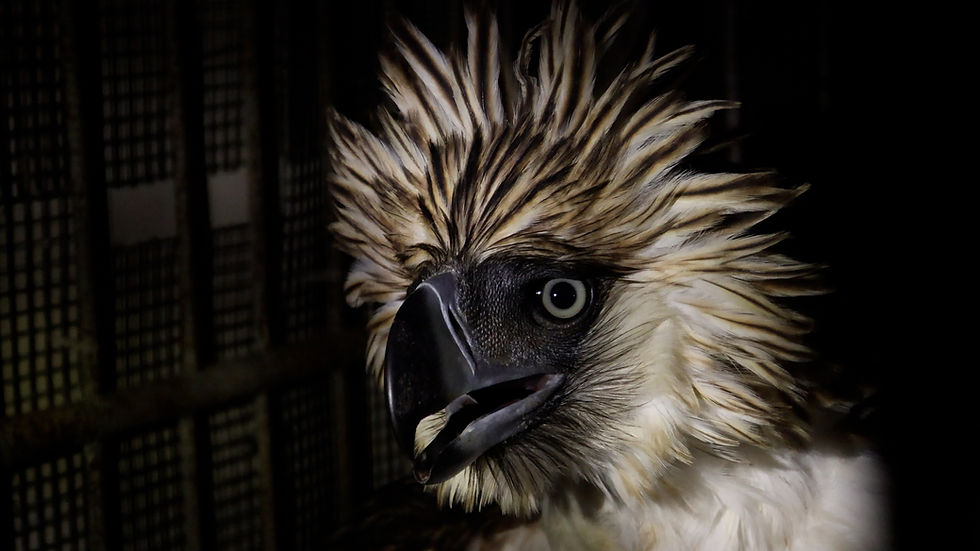
The Philippine Eagle Center in Malagos, Davao City, is best known as a sanctuary for the country’s national bird. Over the years, however, it has become home not only to Philippine Eagles but also to a pair of Saltwater Crocodiles—another fierce apex predator of the Philippines.
If the Philippine Eagle rules the forest canopy and the skies above it, the Saltwater Crocodile occupies the top of the food chain in coastal wetlands, estuaries, rivers, and large lakes. Both species play important roles in maintaining healthy ecosystems, and both face serious threats from human activities.
At the Center, a quiet but meaningful conservation milestone has taken place: the successful pairing of two rescued Saltwater Crocodiles (Crocodylus porosus) named Crocky and Kanluran.
Their story is not simply about breeding. It is a story of rescue, recovery, patience, and careful, science-based wildlife management coming together to give two powerful predators a second chance.
Crocky: A Strong and Territorial Survivor
Crocky, an adult male Saltwater Crocodile, was turned over to the facility in 2021 after being rescued from the illegal wildlife trade. Before his rescue, he had been kept in a private setting where proper care and suitable living conditions were limited.
At the Philippine Eagle Center, Crocky was placed in a modified enclosure that once housed warty pigs. The area was gradually improved to meet his physical and behavioral needs, eventually becoming his established territory.
Crocky displays the typical behavior of an adult male crocodile. He is highly territorial, vigilant, and responsive to movements around his enclosure. He is often seen partially submerged, silently watching his surroundings with only his eyes and nostrils visible above the water.
Despite his aggressive and defensive nature, Crocky has remained healthy under managed care. Proper nutrition, regular enclosure maintenance, veterinary support, and close observation have helped him adapt successfully to his environment.
Kanluran: A Rescue from the Wild
The female Saltwater Crocodile, measuring approximately 11 feet and 5 inches and weighing around 300 kilograms, was rescued in 2017 after becoming accidentally entangled in a fishing net in Liguasan Marsh, Cotabato.
Following her rescue, Kanluran was placed under the temporary protection of the Philippine Army, where she was kept safe and monitored. In 2025, she was transferred to the Philippine Eagle Foundation for long-term rehabilitation and specialized care.
Upon arrival, Kanluran underwent quarantine and acclimatization. This period allowed her to recover, adjust to her new surroundings, and be closely assessed by the animal care and veterinary teams.
Several months later, Kanluran laid eggs.
Although the eggs were not fertilized, their appearance was an encouraging sign. It confirmed that she had reached reproductive maturity and could potentially be paired with a suitable male.

Preparing for Pairing
Introducing two large and powerful crocodiles is never a simple process.
Because Crocky had already established the enclosure as his territory, the team needed to proceed gradually and cautiously. A direct introduction could have resulted in serious injury to either animal.
To reduce the risk, the team installed a strong partition inside the enclosure. This allowed Crocky and Kanluran to see, smell, hear, and sense one another without having direct physical contact.
On February 2, 2026, Kanluran was transferred to the enclosure beside Crocky.
Over the following weeks, the team conducted daily behavioral observations. Every movement mattered. The caregivers watched closely for signs of aggression, avoidance, stress, curiosity, or acceptance.

Signs of Compatibility
Encouraging behaviors soon began to emerge.
Crocky was observed performing what is commonly described as a “water dance.” While submerged, he vibrated his body, creating visible ripples and low-frequency movements through the water.
For crocodiles, these vibrations are an important form of communication. They may signal presence, territoriality, or courtship intentions.
Kanluran repeatedly approached the partition separating them. Rather than retreating or showing signs of distress, she remained calm, attentive, and curious.
These interactions continued over several days. The absence of persistent aggression, combined with their increasing interest in one another, suggested growing tolerance and possible compatibility.
The First Meeting
On April 28, 2026, the team determined that the two crocodiles were ready for their first direct introduction.
Before the partition was opened, Crocky underwent a health assessment led by Dr. Nielsen Donato and documented by the television program Born to Be Wild.
Because of Crocky’s size, strength, and aggressive nature, safely restraining him was challenging. However, the team successfully completed a thorough examination, confirming that he was healthy and physically fit for the introduction.
During this period, Kanluran was also observed producing vibrations in the water. This suggested that she was responding to Crocky even before they made direct contact.
Once the enclosure was secured and the surroundings were calm, the barrier was opened and Crocky was released into Kanluran’s section.
For a moment, there was stillness.
Crocky then slowly moved toward Kanluran through the water. She did not flee or attempt to hide. Instead, she remained calm and allowed him to approach.
Within minutes, the two crocodiles began moving alongside one another and displaying courtship-related behavior. Most importantly, neither animal showed immediate aggression.
The carefully planned introduction had succeeded.

A Shared Space and a New Beginning
Today, Crocky and Kanluran share the same enclosure. Their interactions remain generally compatible, although the team continues to monitor them every day.
Sharing a territory has also led to changes in their behavior. Crocky, in particular, has become more territorial and protective, especially when people approach the enclosure.
These reactions are consistent with the natural behavior of a mature male crocodile during pairing. They also remind the team that successful wildlife care requires constant vigilance and the ability to adjust management practices as animal behavior changes.
More Than an Eagle Sanctuary
The pairing of Crocky and Kanluran also highlights a lesser-known part of the Philippine Eagle Center’s work.
The Center does not care only for eagles. It also provides refuge and professional management for other threatened and rescued wildlife, including one of the most powerful predators found in Philippine aquatic ecosystems.
The Philippine Eagle and the Saltwater Crocodile may occupy very different worlds, but they share similar ecological importance.
The eagle is an apex predator of the forests and skies. The crocodile is an apex predator of coastal wetlands, estuaries, rivers, and large lakes. Their presence helps regulate prey populations and reflects the health and integrity of the ecosystems they inhabit.
Both are also vulnerable to habitat loss, hunting, persecution, accidental capture, and illegal wildlife trade.
Crocky and Kanluran’s successful pairing demonstrates the importance of patience, preparation, veterinary care, and a deep understanding of animal behavior. Their journey—from illegal trade and accidental capture to rehabilitation and a carefully managed introduction—shows what conservation often looks like behind the scenes.
It is quiet, demanding, and highly detailed. It is also guided by science, compassion, and respect for the animals under human care.
Their future is still unfolding, and successful pairing does not guarantee reproduction. However, safely bringing these two rescued crocodiles together is already an important step forward—not only for Crocky and Kanluran, but also for the responsible care and conservation of the Philippines’ remarkable apex predators.
Visit the Philippine Eagle Center in Malagos, Davao City, and witness Crocky and Kanluran’s journey firsthand. See how this formidable crocodile couple continues to adjust to life together. During authorized and staff-supervised feeding activities, you may even have the rare opportunity to help feed them—safely, of course.
Come for the Philippine Eagles, stay to meet another powerful predator, and become part of a conservation story that continues to unfold.


Been using Nano Banana Pro for AI image generation recently. The Pro version handles more complex prompts and delivers sharper results — still powered by Gemini under the hood. Great for concept art and style experiments without any local setup.
A se lekar Gya tak hindi varnmala ko samajhna ab easy lag raha hai. Beginners ke liye achha article hai.
A short TX wiki format works well when you want reference material that is direct and uncomplicated.
Been trying out Nano Banana for AI image generation lately. You just describe what you want in plain text and it generates something — built on Gemini so the quality is decent. Handles a range of styles from realistic to anime. Useful for quick concept visuals without needing to set up anything locally.
The story of a crocodile couple receiving a second chance at the Philippine Eagle Center highlights the importance of wildlife conservation and responsible care for animals. Conservation centers can provide safe environments for rescued or displaced wildlife while helping visitors learn about threatened species and the challenges they face. Stories like this also show how dedicated conservation efforts can give animals another opportunity to thrive. For travelers interested in exploring nature and local experiences, a UAE restaurant guide can also help discover dining options during a visit.